I’m in a frisky mood tonight and I just ran across a blog post about a father-daughter day, so I was reminded of a fathers-and-daughters story of my own. FAIR WARNING!!! This one is not for the easily offended (but it is about nature).
Picture us on a company field trip. We performed biology field work in a miserably cold winter wind all day long. We were windburnt, poison ivied, dehydrated, hungry and just plain whupped from the cold and the rough terrain. All day long we had used hand clippers on our hands and knees to tunnel through greenbriar and poison ivy thickets rather than hack our way with machetes. We were really very tired and stupid by evening, so you can hopefully understand our slowness to comprehend things. You should also know that the city was a coastal tourist town, and the biggest convention there that day was one for new-car dealership owners. Thus, there were a lot of lonely, middle-aged, rather affluent men in town without their wives. Got the picture?
Stupefied, we returned to the hotel that evening, showered and stumbled downstairs to the hotel restaurant below for dinner. We ordered our food and were having before-dinner drinks on our client’s dime, and I’m not talking about iced tea. Of course, that made us even stupider, but what’s your point? Cindy glanced over at the table next to us and noticed that there was a pair of beautiful young women sitting with a pair of fat, middle-aged men, and she said, “Oh look, there’s a couple of fathers and daughters having dinner together!” The rest of us discretely looked over at the foursome and allowed as how, yes, they did make a nice pair of fathers and daughters, and then returned to our own conversation and libations.
But something nagged at me a bit about the scene, so I looked again and saw one of the women lightly slap the hand of one of the men that had gone where it shouldn’t have gone in a restaurant, and it was then that I noticed that the dining room was filled, literally filled with “fathers and daughters.” I kid you not, that room had a hundred alluring, fetchingly dressed young women sitting with a hundred fat, middle-aged new car dealers, and with the glee that only a 25yo tipsy bachelor can muster, I pointed this out to my group. The look on Cindy’s face as she realized what was really going on was absolutely priceless – a kind of a shock that turned to horror that eventually relaxed into exuberant humor!
Myrtle Beach, Virginia sure has a lot of starlets.
Dicromantispa interrupta

Mantisfly
Tuesday, August 17, 2010


Saturday, August 14, 2010
Chassahowitzka Swamp in August
I couldn't raise the troops for a trek into the Chazz Swamp, so I went there solo on Saturday. It's about a 1:45 hour drive thanks to all the schlocky podunks from Inglis on south to just north of Thresher Road where one turns west to enter the Chazz WMA. The limerock road you turn into is actually named Indigo Road, but there is no sign for that at US 19. I paid my three bucks and drove on in. The goal was to get an idea of the terrain north and east of where I have been before, to check out the so-called Sink 311A that was named by some cave diver and to look for more karst features yet unknown to me. Here is what my 5.1-mile dayhike looks like on Google Earth:
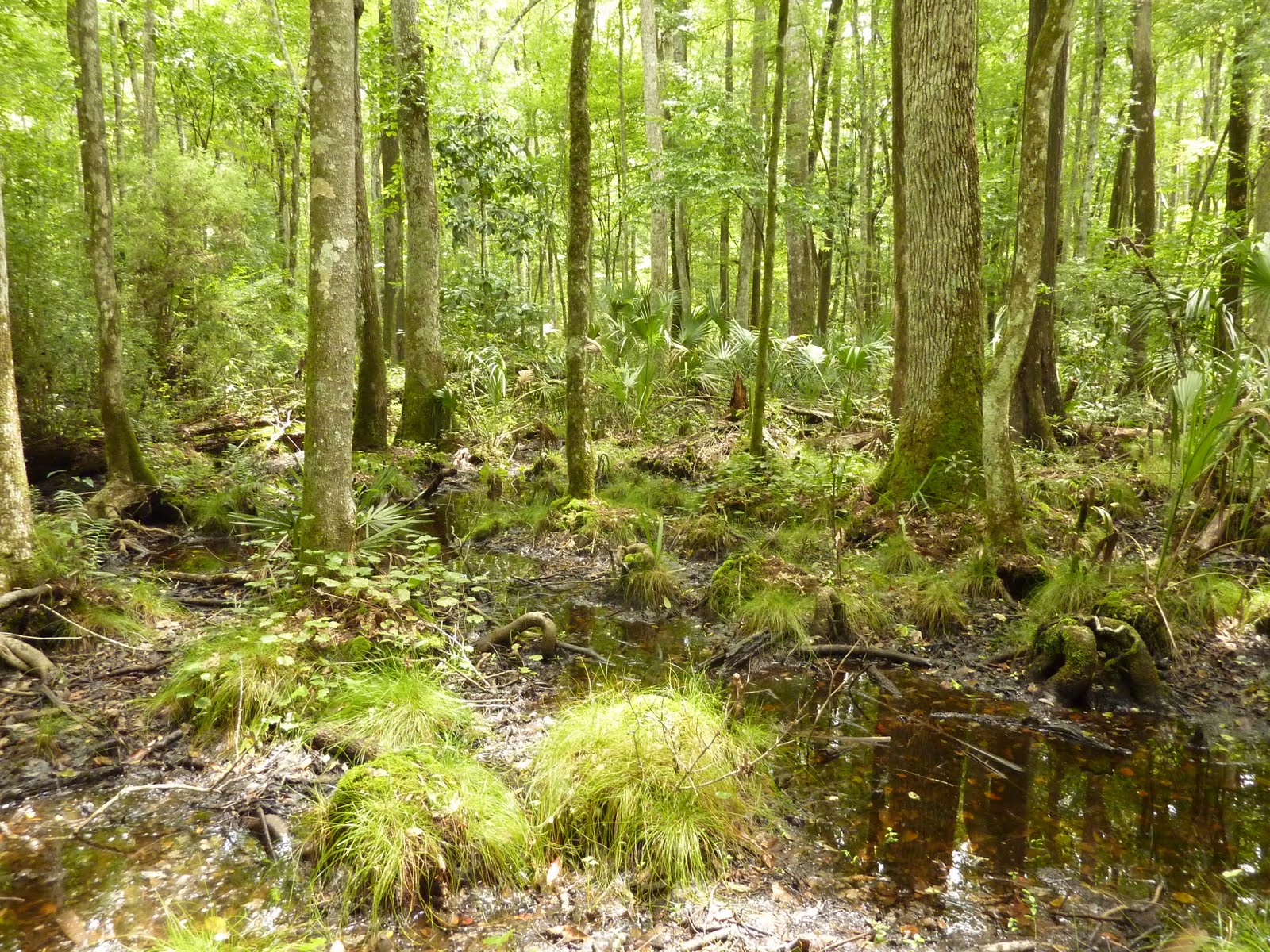
Some of my buddies have the idea to camp out in the swamp while on a 2-day wander around the place. I tried to convince them of their folly but they just called me a wuss. Harumph! These photos, which are typical in every way of the Chazz Swamp, should convince anyone that camping there in tents and sleeping bags is an odd idea.


But there are some neat things to see there, like cabbage palms cloaked with shoestring fern (Vittaria lineata).
And a view of the clear waters of Blind Creek with snags and three young alligators sunning themselves.
And Pool 8 (dunno its Christian name), with its limestone ledge above a sheer drop into cool, deep water.
And this pair of unidentified blue mushrooms that have emerged from below thick leaf litter to look like alien blue eggs in a cupped nest.
People talk all the time about cypress knees and debate what their function is, but I am just as pleased at the knees of other tree species like swamp tupelo (Nyssa sylvatica var. biflora) and sweetgum (Magnolia virginiana).
Did you notice the deer bones scattered to the right of the knees? I did not notice them until stooping down to snap the shot.
There was plastic flagging everywhere I went out there, red, orange, blue and candy-striped, plus three plastic balloons. So much for wilderness! OTOH, there was very little sign of feral pigs, perhaps because there is so little food for them this time of year. Other interesting biota seen included a striped mud turtle (Kinosternon bauri), beau coups corkwood plants (Leitneria floridana) and a terrestrial Habenaria orchid, possibly H. odorata, which we have seen blooming out there before.
Lastly, the prescribed burns that the State is conducting in the pine flatwoods and sandhill habitats are doing great things! Oaks and slash pines are being killed back, allowing for an abundance of ground plants for gopher tortoises to feed on. The burns will eventually result in a greater abundance of the large-seeded longleaf pine. Many of the herbs are in bloom and support diverse pollinators, and the longleafs will provide sustenance for the threatened fox squirrel. Gopher tortoise burrows were abundant, and goldenrod provided great swaths of cheerful color. I didn't even mind that I was soaked in perspiration and swamp water by the time I returned to the truck.

Some of my buddies have the idea to camp out in the swamp while on a 2-day wander around the place. I tried to convince them of their folly but they just called me a wuss. Harumph! These photos, which are typical in every way of the Chazz Swamp, should convince anyone that camping there in tents and sleeping bags is an odd idea.




But there are some neat things to see there, like cabbage palms cloaked with shoestring fern (Vittaria lineata).

And a view of the clear waters of Blind Creek with snags and three young alligators sunning themselves.

And Pool 8 (dunno its Christian name), with its limestone ledge above a sheer drop into cool, deep water.

And this pair of unidentified blue mushrooms that have emerged from below thick leaf litter to look like alien blue eggs in a cupped nest.

People talk all the time about cypress knees and debate what their function is, but I am just as pleased at the knees of other tree species like swamp tupelo (Nyssa sylvatica var. biflora) and sweetgum (Magnolia virginiana).

Did you notice the deer bones scattered to the right of the knees? I did not notice them until stooping down to snap the shot.
There was plastic flagging everywhere I went out there, red, orange, blue and candy-striped, plus three plastic balloons. So much for wilderness! OTOH, there was very little sign of feral pigs, perhaps because there is so little food for them this time of year. Other interesting biota seen included a striped mud turtle (Kinosternon bauri), beau coups corkwood plants (Leitneria floridana) and a terrestrial Habenaria orchid, possibly H. odorata, which we have seen blooming out there before.
Lastly, the prescribed burns that the State is conducting in the pine flatwoods and sandhill habitats are doing great things! Oaks and slash pines are being killed back, allowing for an abundance of ground plants for gopher tortoises to feed on. The burns will eventually result in a greater abundance of the large-seeded longleaf pine. Many of the herbs are in bloom and support diverse pollinators, and the longleafs will provide sustenance for the threatened fox squirrel. Gopher tortoise burrows were abundant, and goldenrod provided great swaths of cheerful color. I didn't even mind that I was soaked in perspiration and swamp water by the time I returned to the truck.
Sunday, August 1, 2010
Swimmin' with 'gators and spiders, oh my!
Ok, lately I HAVE been having fun. One recent afternoon included swimming in a swamp braid of the Wekiva Spring Run where it crosses CR 326 in Levy County. A quick look at the situation where some of my buds were cooling off will give you an idea of the place:

Of course, you have to be totally unafraid of alligators and cottonmouths to swim here. Bruce, Bill, Jon and I did so, but Lisa deferred. Um, you also should be unafraid of giant spiders:
That tree it is on is appx 4.5 inches thick. Trying to id the beast, I found a site that has several fishing spider photos and the similarities are great. Thus, I think it is a Dolomedes in the family Pisauridae, otherwise known as fishing spiders, probably neither D. albolineatus, the white banded fishing spider nor D. triton. I found a video of a D. okefinokensi adult female, but the abdominal dorsal pattern is wrong and their femme does not have a white perimeter band:
http://www.youtube.com/watch?v=y1p8bx374nM.
Pesce on SpiderIdentification.org suggested it might be D. tenebrosus. Their pic, of a male, is very similar but does not have the white perimeter around the central black spot on the cephalothorax that ours has. That could be explained by gender difference or by individual variation? Unfortch, a bugguide.com range map does not depict it as being in Florida, but that map is obviously gappy. Various web sites claim it is North America’s largest spider. Davesgarden.com (http://davesgarden.com/guides/bf/showimage/2447/) has a bunch of D. tenebrosus pics, but all show brownish specimens without the white perimeter band. Our specimen is grayish.
The NC website has a pic of Dolomedes scriptus, and it is almost a dead ringer for our octopedded monster, except that theirs is a little browner and has a less obvious white perimeter band around the dorsal black spot:
http://www.carolinanature.com/spiders/spider2624.jpg. OTOH, the Wikipedia entry for that species depicts and describes a white stripe down the sides of the animal, in full conflict with the Carolina site. Egad! Will the real D. scriptus please stand up!
Interestingly, fishing spiders crouch on top of the water with the two hindmost legs anchored to a floating leaf or whatnot, and then plunge downward into the water while still holding onto the leaf to grab their prey, usually a fish or invertebrate, but I bet they will also take small frogs as their African relative, Ancylometes rufus, is shown to do in this video: http://www.youtube.com/watch?v=zv7YSEIOxwo&feature=fvw. Male fishing spiders are known to tie up the females with silk prior to mating. Hey, bondage is what I’d do if my ladies were bigger and hungrier than me!


Of course, you have to be totally unafraid of alligators and cottonmouths to swim here. Bruce, Bill, Jon and I did so, but Lisa deferred. Um, you also should be unafraid of giant spiders:

That tree it is on is appx 4.5 inches thick. Trying to id the beast, I found a site that has several fishing spider photos and the similarities are great. Thus, I think it is a Dolomedes in the family Pisauridae, otherwise known as fishing spiders, probably neither D. albolineatus, the white banded fishing spider nor D. triton. I found a video of a D. okefinokensi adult female, but the abdominal dorsal pattern is wrong and their femme does not have a white perimeter band:
http://www.youtube.com/watch?v=y1p8bx374nM.
Pesce on SpiderIdentification.org suggested it might be D. tenebrosus. Their pic, of a male, is very similar but does not have the white perimeter around the central black spot on the cephalothorax that ours has. That could be explained by gender difference or by individual variation? Unfortch, a bugguide.com range map does not depict it as being in Florida, but that map is obviously gappy. Various web sites claim it is North America’s largest spider. Davesgarden.com (http://davesgarden.com/guides/bf/showimage/2447/) has a bunch of D. tenebrosus pics, but all show brownish specimens without the white perimeter band. Our specimen is grayish.
The NC website has a pic of Dolomedes scriptus, and it is almost a dead ringer for our octopedded monster, except that theirs is a little browner and has a less obvious white perimeter band around the dorsal black spot:
http://www.carolinanature.com/spiders/spider2624.jpg. OTOH, the Wikipedia entry for that species depicts and describes a white stripe down the sides of the animal, in full conflict with the Carolina site. Egad! Will the real D. scriptus please stand up!
Interestingly, fishing spiders crouch on top of the water with the two hindmost legs anchored to a floating leaf or whatnot, and then plunge downward into the water while still holding onto the leaf to grab their prey, usually a fish or invertebrate, but I bet they will also take small frogs as their African relative, Ancylometes rufus, is shown to do in this video: http://www.youtube.com/watch?v=zv7YSEIOxwo&feature=fvw. Male fishing spiders are known to tie up the females with silk prior to mating. Hey, bondage is what I’d do if my ladies were bigger and hungrier than me!
Monday, July 12, 2010
Wildlife Marking Trees
As you can clearly deduce from the lack of recent postings to this blog, I just haven’t been having much fun lately. Oh well, I guess I’ll just have to synopsize an article recently published in the summer 2010 issue of the Wildlife Professional, which is the non-technical quarterly read of The Wildlife Society. The article is entitled “How animals send ‘tree mail.’” If the Camera Codger and Henry, two camera trappers that I greatly admire still read my blog, they and other camera trappers should pay special attention.
Cam McTavish and Michael Gibeau have written a marvelous piece about trees that are used by wildlife as marking posts to inform other animals about their presence. Their research was based on >16,000 camera-nights, plus winter-time tracks in the snow. As a result, these fellows have uncovered a hitherto unknown galaxy of behavior and camera trapping opportunities. As you all know, many species of mammals mark certain trees as a way to alert conspecifics (same species) and other species of their presence. It can be done to mark territorial boundaries, scare away competitors and advertise their physical prowess and sexual state, among other things. Here's a black bear-marked cabbage palm tree I photographed somewhere (I forget) that has some pretty deep claw marks:

Surprising to me, however, is the relatively large number of ways that mammals use to mark trees. This includes biting and scratching by bears; scratching the ground around the trees by canids and felids; rubbing the bark by the mountain goat, bears and wolverine; defecation adjacent to and up to 20+ meters away by canids and felids; and spraying or rubbing of anal matter by the wolverine and felids.
Their list of marking species reads like a who’s who of mammalian predators, including grizzly bear, black bear, gray wolf, coyote, red fox, Canada lynx, cougar, wolverine, dog and martin. They also found a fair number of herbivorous species using marker trees: mule deer, white-tail deer, moose, elk, bighorn sheep, mountain goat, red squirrel, wood rat and porcupine. Other research has shown that many other species from bumblebees to hyenas worldwide use scent marking on trees. Feral pigs commonly rub trees around these parts.
We have all seen trees and shrubs marked by claws, antlers and hair, and I have always thought such tree mail was aimed at their own species, but this is emphatically not so! Using camera traps, they documented that marks by grizzly bears caught the attention of mountain goats, for instance, some of whom then also marked the tree, and mule deer will go well out of their way to investigate scent markings. Some marked trees were used by up to seven species.
Any species or size of tree can be marked. Age, girth and bark roughness of the trees make no difference. They are typically found beside animal and human trails and along fire lanes, power line ROWs and, get this, seismic lines! Although aspect (facing direction) makes no difference, they are usually on the downhill side of the trail. Most commonly, communication trees are at trail junctures where many species would tend to cross paths.
In most cases, predators actively used (marked) the trees whereas prey species used them only passively (sniffing). Obviously, predators want to advertise themselves to and fend off other meat-eaters while prey animals just want to learn which killers have recently passed by and might be nearby threats.
Other interesting characteristics of active users are:
-) Scent marks are often made by individuals that are dominant over and tolerant of conspecifics.
-) Scent marking can synchronize menstruation in females of a species.
-) Scent marking affects socio-sexual behavior and conspecific fertility, thus possibly reducing aggressive encounters.
-) Because small species of felids scent mark primarily when they are sexually active, fertility may be suppressed when their populations are high.
-) The variety of methods used for marking (paws, claws, scent, hair, etc.) may pass on other messages besides the obvious ones like “I am here” and “I am looking for love.”
McTavish and Gibeau also point out that some marker trees have been used for generations, up to 150 years for bear in one instance, and conclude that the loss of these special trees might have adverse effects that have been overlooked. For example, such trees might be terrific locations to conduct long term wildlife research, or their loss might cause additional inter- and intraspecific confrontations among local wildlife. All I know is that when my favorite stores go out of business, I am as lost as a lizard on a piece of driftwood sailing out to sea. So we might want to sleuth them out and try to save them from the land manager’s chain saw, although I don’t think I’d want to chain myself to a predator attractor!
Remind me to tell you some day about Richard and the black bear rub tree on Mormon Branch in Florida’s Ocala National Forest. It’s a hoot.
Cam McTavish and Michael Gibeau have written a marvelous piece about trees that are used by wildlife as marking posts to inform other animals about their presence. Their research was based on >16,000 camera-nights, plus winter-time tracks in the snow. As a result, these fellows have uncovered a hitherto unknown galaxy of behavior and camera trapping opportunities. As you all know, many species of mammals mark certain trees as a way to alert conspecifics (same species) and other species of their presence. It can be done to mark territorial boundaries, scare away competitors and advertise their physical prowess and sexual state, among other things. Here's a black bear-marked cabbage palm tree I photographed somewhere (I forget) that has some pretty deep claw marks:

Surprising to me, however, is the relatively large number of ways that mammals use to mark trees. This includes biting and scratching by bears; scratching the ground around the trees by canids and felids; rubbing the bark by the mountain goat, bears and wolverine; defecation adjacent to and up to 20+ meters away by canids and felids; and spraying or rubbing of anal matter by the wolverine and felids.
Their list of marking species reads like a who’s who of mammalian predators, including grizzly bear, black bear, gray wolf, coyote, red fox, Canada lynx, cougar, wolverine, dog and martin. They also found a fair number of herbivorous species using marker trees: mule deer, white-tail deer, moose, elk, bighorn sheep, mountain goat, red squirrel, wood rat and porcupine. Other research has shown that many other species from bumblebees to hyenas worldwide use scent marking on trees. Feral pigs commonly rub trees around these parts.
We have all seen trees and shrubs marked by claws, antlers and hair, and I have always thought such tree mail was aimed at their own species, but this is emphatically not so! Using camera traps, they documented that marks by grizzly bears caught the attention of mountain goats, for instance, some of whom then also marked the tree, and mule deer will go well out of their way to investigate scent markings. Some marked trees were used by up to seven species.
Any species or size of tree can be marked. Age, girth and bark roughness of the trees make no difference. They are typically found beside animal and human trails and along fire lanes, power line ROWs and, get this, seismic lines! Although aspect (facing direction) makes no difference, they are usually on the downhill side of the trail. Most commonly, communication trees are at trail junctures where many species would tend to cross paths.
In most cases, predators actively used (marked) the trees whereas prey species used them only passively (sniffing). Obviously, predators want to advertise themselves to and fend off other meat-eaters while prey animals just want to learn which killers have recently passed by and might be nearby threats.
Other interesting characteristics of active users are:
-) Scent marks are often made by individuals that are dominant over and tolerant of conspecifics.
-) Scent marking can synchronize menstruation in females of a species.
-) Scent marking affects socio-sexual behavior and conspecific fertility, thus possibly reducing aggressive encounters.
-) Because small species of felids scent mark primarily when they are sexually active, fertility may be suppressed when their populations are high.
-) The variety of methods used for marking (paws, claws, scent, hair, etc.) may pass on other messages besides the obvious ones like “I am here” and “I am looking for love.”
McTavish and Gibeau also point out that some marker trees have been used for generations, up to 150 years for bear in one instance, and conclude that the loss of these special trees might have adverse effects that have been overlooked. For example, such trees might be terrific locations to conduct long term wildlife research, or their loss might cause additional inter- and intraspecific confrontations among local wildlife. All I know is that when my favorite stores go out of business, I am as lost as a lizard on a piece of driftwood sailing out to sea. So we might want to sleuth them out and try to save them from the land manager’s chain saw, although I don’t think I’d want to chain myself to a predator attractor!
Remind me to tell you some day about Richard and the black bear rub tree on Mormon Branch in Florida’s Ocala National Forest. It’s a hoot.
Friday, May 28, 2010
Onions are a Jones
I love to putter around in the garden just about as much anything. It is so good for the soul, this creation of food from "first principles." Weeds don't have a chance under the gaze of this gardener, although I transplant some of them to more appropriate places. Today I noticed that my grocery store ginger root had sprouted more roots plus shoots. Some folks would just throw it out, but a gardener will consider this a second bite at the apple. So into the garden it went, taking me only about 2 minutes to walk out and back and plant the little sucker. Maintaining a garden after it is set up is easy, taking only an hour or two a week to do the job including harvesting. Mother Garden nurtures me even when I'm on away missions, by provisioning me before the trip and chugging along in my absence. Here are my May harvests, ex radishes and snap beans that got eaten before photoed. Not a lot carbs, I'll admit, but maybe someday people will say, "Buford really knows his onions!"
.JPG)
.JPG)
.JPG)
.JPG)
.JPG)
.JPG)
Saturday, May 22, 2010
Neandertal Debt
In the sidebar entitled, Cloned Neandertals Still in the Realm of Sci-Fi? (Science, vol. 328:682-683), Elizabeth Pennisi quotes several scholars as questioning why we would want to bring Neandertals back to life in the first place. I agree with them that it is wrong to do so to satisfy scientific curiosity, but suggest another reason: If Modern Man had a hand in the extinction of Neandertal, perhaps we owe it to them to bring them back? We were more brutal when they died out, and they were brutal, too, but today we are more paternal toward endangered species. Doubtless, if they were extant but imperiled, we would take steps to ensure their survival just as we are doing with other jeopardized species today.
There are, of course, other ethical questions to consider. The sidebar asked, for example, if it is ethical for a human surrogate mother to carry the fetus of another species, but we don’t even have to ask the religious world’s opinion on that one. Another ethical question that was not asked in the sidebar is whether we really want to force some Neo-Neandertals to grow up and live in a Sapiens world knowing of their species’ tragic fate. It could be heart-wrenching all around.
There are, of course, other ethical questions to consider. The sidebar asked, for example, if it is ethical for a human surrogate mother to carry the fetus of another species, but we don’t even have to ask the religious world’s opinion on that one. Another ethical question that was not asked in the sidebar is whether we really want to force some Neo-Neandertals to grow up and live in a Sapiens world knowing of their species’ tragic fate. It could be heart-wrenching all around.
Thursday, May 20, 2010
A long three weeks
I have not written to this blog in almost a month because of the intensity of my current field work, having been out of town and working 12 – 16 hrs a day since late April. It’s a grinding schedule, but the money and experiences are good. I have been primarily relocating gopher tortoises from the pipeline right-of-way (R/W), occasionally interspersing that work with searching for endangered species on small parcels. After getting only one day off over the past three weeks, I may be getting off today through Memorial Day, say “Hallelujah!”
The word, “relocating,” that I used above is a bit misleading, as it refers only to disposition. To be more complete about it, what we do is dig up gopher tortoises (Gopherus polyphemus) using shovel and backhoe and then move them out of harm’s way, either by releasing them elsewhere on site or taking them to an off-site preservation area. Before release, we collect a fair amount of information on the animals (e.g., weight, length) and use a scute-notching system to semi-permanently number them. Commensal species are sometimes encountered in the burrows and are allowed to escape, although capture and release on site is appropriate in some situations.
Along the way, I am working within my first union featherbedding experience. Only three people are needed to excavate the turtles: an “agent” that is a state-certified tortoise mover -that’s me; the “hole-jumper” - BrianM has been my assistant and a safety backup so far; and the backhoe operator – Joel, a “competent person.” The first day, there were not just the three of us, but actually ten people: we three essential fellows (sniff), two inspectors, four laborers and a foreman. From the second day onward, that number was pared down to eight! And all of us are men. I am reminded of a satiric imitation sea shanty that was played occasionally on the radio twenty or so years back that was sung by deep-voiced men in their best “row, row, row your boat” marching canter that started out something like this:
“Men, men, men, men,
Men, men, men, men,
It’s great to be with men,
I love to be with men,
Etcetera”
Well, let me tell you, the sandhills are a different kind of sea and the clanking of the backhoe is not exactly a chantie, and I can think of a lot of women I’d rather spend my working days with than some of those men.
Ok, let’s have some pictures…
Here’s a young indigo snake (Drymarchon corais couperi) that we dug out of a shallow armadillo burrow in a farm crop field where it was directly in the path of construction:+5-13-10+A1b(1).jpg)
+5-13-10+A2b(1).jpg)
We took it some distance away from the construction area and released it into a ditch-side briar thicket. Of all the places I would expect to see this federally-threatened species, an intensively plowed and sprayed ag field is not it. But there’s more to this place than meets the eye. At first, one sees the recently-mowed field’s late summer weeds chopped and strewn about, and a series of ditches rectangularizing the former wet prairie. The ditches are overgrown with thick ruderal vegetation, including brush, briars and vines, while cattle and feral pigs wallow in wet puddles at the edge of the field.
But, looking closely at the ditch water, you don’t see the pea-green soup that ordinarily flows through Florida’s vegetable fields. Instead, this water is clear to the bottom and has thick growths of submerged plants. Where is this spring water coming from?
Being physiographic about it, we are standing on a once-submerged terrace that is flatter’n a pancake. Only a few hundred feet away is the eastern toe of slope of the Lake Wales Ridge, an extremely sandy “Plio-Pleistocene island” with a very steep gradient – my friend Tom Morris compares it to a loaf of bread in cross-section. Rainwater percolates easily through the soil down to the water table and then moves laterally to the toe of slope where it arises as a series of seepage springs. These, then, are the sources of the field’s ditch water base flow and where livestock bathe. Can you imagine how beautiful these springs and associated streams and wetlands must have appeared before being squandered on dirt farming? Truly, these are “pearls before swine.”
I propose that the public acquire a strip of land, perhaps only 200 – 300 yds wide, running along the toe of this slope where seeps are abundant that would exclude agricultural activities for the purposes of restoring native seepage spring habitats, providing for surface water quality protection and perhaps even adding to our portfolio of recreational wild lands. Protection of this strip of habitat would continue to provide water for ag operations, yet would remove only a tiny acreage from ag production. It would cost but little due to the small acreage involved and the fact that ag land is relatively cheap, especially these days. I propose to employ eminent domain if it becomes necessary to retrieve these tarnished jewels.
Ok, off the soapbox again, and now for some tortoise pics. Here’s a close-up one of one little fellow that was shedding some neck skin:.JPG)
Here’s four juvenile tortoises excavated from a single burrow:.JPG)
These four were caught and marked a few days before, but they found a hole in the silt fence and returned to their territories, taking shelter in the burrow nearest the hole. But fear not, gentle reader, as they were re-released outside of the R/W, and are known to be able to dig a new burrow in only 2 - 3 days. Gopher tortoises dig down generally at a 30 – 45 degree angle until they reach the water table, then level the burrow off and construct a nest chamber. Here is a shot of BrianM pulling an adult tortoise up out of the water that filled the nest chamber when rains elevated the local groundwater level:.JPG)
The word, “relocating,” that I used above is a bit misleading, as it refers only to disposition. To be more complete about it, what we do is dig up gopher tortoises (Gopherus polyphemus) using shovel and backhoe and then move them out of harm’s way, either by releasing them elsewhere on site or taking them to an off-site preservation area. Before release, we collect a fair amount of information on the animals (e.g., weight, length) and use a scute-notching system to semi-permanently number them. Commensal species are sometimes encountered in the burrows and are allowed to escape, although capture and release on site is appropriate in some situations.
Along the way, I am working within my first union featherbedding experience. Only three people are needed to excavate the turtles: an “agent” that is a state-certified tortoise mover -that’s me; the “hole-jumper” - BrianM has been my assistant and a safety backup so far; and the backhoe operator – Joel, a “competent person.” The first day, there were not just the three of us, but actually ten people: we three essential fellows (sniff), two inspectors, four laborers and a foreman. From the second day onward, that number was pared down to eight! And all of us are men. I am reminded of a satiric imitation sea shanty that was played occasionally on the radio twenty or so years back that was sung by deep-voiced men in their best “row, row, row your boat” marching canter that started out something like this:
“Men, men, men, men,
Men, men, men, men,
It’s great to be with men,
I love to be with men,
Etcetera”
Well, let me tell you, the sandhills are a different kind of sea and the clanking of the backhoe is not exactly a chantie, and I can think of a lot of women I’d rather spend my working days with than some of those men.
Ok, let’s have some pictures…
Here’s a young indigo snake (Drymarchon corais couperi) that we dug out of a shallow armadillo burrow in a farm crop field where it was directly in the path of construction:
+5-13-10+A1b(1).jpg)
+5-13-10+A2b(1).jpg)
We took it some distance away from the construction area and released it into a ditch-side briar thicket. Of all the places I would expect to see this federally-threatened species, an intensively plowed and sprayed ag field is not it. But there’s more to this place than meets the eye. At first, one sees the recently-mowed field’s late summer weeds chopped and strewn about, and a series of ditches rectangularizing the former wet prairie. The ditches are overgrown with thick ruderal vegetation, including brush, briars and vines, while cattle and feral pigs wallow in wet puddles at the edge of the field.
But, looking closely at the ditch water, you don’t see the pea-green soup that ordinarily flows through Florida’s vegetable fields. Instead, this water is clear to the bottom and has thick growths of submerged plants. Where is this spring water coming from?
Being physiographic about it, we are standing on a once-submerged terrace that is flatter’n a pancake. Only a few hundred feet away is the eastern toe of slope of the Lake Wales Ridge, an extremely sandy “Plio-Pleistocene island” with a very steep gradient – my friend Tom Morris compares it to a loaf of bread in cross-section. Rainwater percolates easily through the soil down to the water table and then moves laterally to the toe of slope where it arises as a series of seepage springs. These, then, are the sources of the field’s ditch water base flow and where livestock bathe. Can you imagine how beautiful these springs and associated streams and wetlands must have appeared before being squandered on dirt farming? Truly, these are “pearls before swine.”
I propose that the public acquire a strip of land, perhaps only 200 – 300 yds wide, running along the toe of this slope where seeps are abundant that would exclude agricultural activities for the purposes of restoring native seepage spring habitats, providing for surface water quality protection and perhaps even adding to our portfolio of recreational wild lands. Protection of this strip of habitat would continue to provide water for ag operations, yet would remove only a tiny acreage from ag production. It would cost but little due to the small acreage involved and the fact that ag land is relatively cheap, especially these days. I propose to employ eminent domain if it becomes necessary to retrieve these tarnished jewels.
Ok, off the soapbox again, and now for some tortoise pics. Here’s a close-up one of one little fellow that was shedding some neck skin:
.JPG)
Here’s four juvenile tortoises excavated from a single burrow:
.JPG)
These four were caught and marked a few days before, but they found a hole in the silt fence and returned to their territories, taking shelter in the burrow nearest the hole. But fear not, gentle reader, as they were re-released outside of the R/W, and are known to be able to dig a new burrow in only 2 - 3 days. Gopher tortoises dig down generally at a 30 – 45 degree angle until they reach the water table, then level the burrow off and construct a nest chamber. Here is a shot of BrianM pulling an adult tortoise up out of the water that filled the nest chamber when rains elevated the local groundwater level:
.JPG)
Subscribe to:
Posts (Atom)