Consider the possibility that a sentient species on a
planet in another star system acquires advanced fusion technology. That is,
they can not only fuse hydrogen atoms together to make helium and useable
energy, but also gold for self-enrichment or rare and heavy metals for machines
like cars, planes, and space ships. After some period of time, their fusion
industries might overweight their atmosphere in these heavier metals relative
to pre-industrial background levels. If we construct sensors that can measure
elements in distant planetary atmospheres, then would this be a way to detect
advanced alien civilizations?
Dicromantispa interrupta
Mantisfly
Friday, January 15, 2016
Tuesday, July 28, 2015
Seahorse Key Rookery Abandonment
There’s a mystery a-cooking in the cays of Cedar Key.
A
long-time major seabird rookery on Seahorse Key was suddenly abandoned this
spring and the cause is currently unknown. It’s all over the north Florida online
news. Now comes word that seven raccoons have been trapped and relocated from
the island, and the trapper believes that eight or ten raccoons were on the
island when the birds fled. However, raccoons are not known to be a serious predator of rookeries, and broken eggshells found under the nests showed no
sign of destruction by raccoons.
The trapper noted that these raccoons were sleek and
robust and just sat and looked at him from the cages, whereas in his (and my)
experience, trapped raccoons are snarling, snapping, lean wild beasts. This
indicates that these particular raccoons were subsidized by humans, and together
with the eggshells, were not the cause this avian catastrophe.
I camped at a state park in west Florida in the late 1970s
and saw about 20 (maybe 30) raccoons and feral cats come out of the woods when
the sun set and a full moon rose over the campground. Laying in my sleeping bag
in the pickup truck bed, I looked out the windows of the camper top and watched
them forage around the campground, kind of like watching an African savannah wildlife
show on TV. Unabashed pilferers, each worked the campsite independently,
investigating every camper nook and cranny like a regiment of army ants
blanketing and repeatedly gleaning a patch of ground. I watched as a raccoon
broke into a neighbor's ice cooler (park signs gave fair warning). One animal
even tried to dig up through the steel bed of my pickup truck as I lay above it
admiring its tenacity while at the same time being astonished that park staff
didn't trap them out. It would have been easy to trap them out. Alas, I didn't
get out and see what these scavengers would do if I walked through them; maybe
they would have just sat there and watched me.
It doesn't take long to trap 10 campground raccoons and
run them over to an island in the middle of the night. My best guess is that
some dingbat finally got tired of them stealing from a backyard zoo (county
park, farm, shelter, trash dump, hoarder...), and not wanting to kill the poor
wittle things, got a holding cage and a couple of traps and a boat.
OTOH, if you like raccoons and collect them over a period
of a few years in a big backyard cage, and then get tired of having them around
but can't bear to kill the poor wittle things, well then, dumping them on an
island where they can't find their way back home might seem to be an option to the
thoughtless.
We found a set of raccoon tracks on nearby Atsena Otie
Key in 2010:
How did that raccoon get there? I just assumed it swam
there, or accidentally drifted over during a storm. Seahorse Key is much
further from land than Atsena Otie, so a raccoon would have to like swimming
over feeding shallows against tidal currents at night. Raccoons swim just fine,
although they are not strong swimmers. But I don’t know…
What if some backyard zookeeper is periodically trapping
a mess of raccoons and dumping them, first on this island and then on the next?
Heh, even the Seahorse Key trapper is relocating the ‘coons somewhere. I wonder
where? Another island? Another stewpot?
Saturday, June 27, 2015
Are Texas Warthogs Coming?
As you may know, the USDA has been working on a national
plan to control feral swine (hogs, pigs), and I did my civic duty and gave them
my two cents worth. Now comes a blurb from the news media that warthogs are on
the loose in Texas and, oh by the way, that’s old news. Here’s one example: tinyurl.com/ncpgwa8.
Well, maybe in Texas it’s old news. I follow the feral
hog situation because of my involvement in the Emerald Pendant project, but
never once ran across warthogs in my literature review. Evidently, most if not
all of these burrowing barrows escaped from high-dollar sitting-duck hunting reserves,
although a few may have also been released by exotic-pig faddists. Apparently, it
is not common enough to be widely perceived as an invasive-exotic threat, and
may not even be reproducing in Texas yet. What is its potential to become an
over-abundant pest? Well, the leopard and the lion and the Lango have all been
unable to control them in Africa, and their cousin, the Eurasian boar, well,
you know…
The common warthog is a savannah grazer, which means it
prefers grasslands to forests and focuses on eating graminoids, but also eats
roots, tubers, berries, nuts, crops, insects, eggs, and carrion. For sure, it
will eat any herp it runs across. These are exactly the same foods that feral
hogs eat. The warthog lives in sounders, like feral hogs, but unlike them is
said not to occupy territories. If the latter is true, then warthog sounders could
be more difficult to trap with the whole-sounder approach than feral hogs. One
obvious biological error in the article cited above is the idea that warthogs
are not nocturnal like feral hogs. Actually, hogs are indeed naturally diurnal,
but become nocturnal where humans hunt them. There is no reason to believe that
warthogs would not similarly adapt the shroud of the night. The warthog can
occur in densities of up to 77 per km2, or 1 per 3.25 acres, but a
more typical density is 1-10 per km2, comparable to American feral
hogs.
The warthog’s gestation period is 5-6 months, far longer
than that of the feral hog, so while the latter can have two or more litters
per year at 4-8 young each, the warthog has only one litter of 2-4 young per
year. If warthogs become established and strong control efforts are used on
them, would the number of litters per year and number of young per litter
increase in the face of significant control pressure? Research shows that feral
hogs become more fecund when hunted and trapped, so warthogs could easily follow
suit. The genes are almost certainly present in warthogs, as humans have bred
super-fecundity into domestic pigs, dogs, sheep, and chickens, among others. Warthog
birthing occurs at the start of the rainy season, which happens at variable
times throughout the warthog’s native range in Africa, so it would probably adapt
to American rainfall seasons.
On the bright side, drought and hunting with dogs can
extirpate the warthog locally. Furthermore, the warthog does not have
subcutaneous fat and its hair is sparse, so the warthog suffers in the cold; hence,
the burrows. However, sparse hair and absent fat layers are possibly controlled
by a single or few genes each, and if one (set) is the only thing keeping warthogs
from breeding in the US today, then a single mutation could be a game-changer.
Environmental stresses can force mutations.
There are two species of warthogs in Africa: the common and
the desert, or Ethiopian. I don’t know which one is on the hoof in Texas, but
the native landscape of the desert warthog is arid brushland and thickets,
which sounds a lot like the Texas Hill Country. Regardless, there appears to be
potentially suitable habitat in Texas and Mexico for both species.
The prospects for extirpating warthogs from Texas appear favorable.
First, outlaw their importation, breeding, keeping, and hunting. Second, send
in specially trained professional exterminators/hunters using every reasonable trick
in the book (e.g., hunting with
warthog-trained hunting dogs, Judas warthogs, whole-sounder trapping, and
aerial surveys and shooting). Third, fold warthog concerns into national and
state monitoring and public education campaigns.
Perhaps the USDA should focus a sufficient chunk of its national
swine control resources on warthogs before
they become as abundant and destructive as feral swine. USDA could fund genomic
research on the potential for mutations that enable subcutaneous fat and/or
denser hair. Research into the likelihood of warthogs acclimating to a
nocturnal lifestyle may be warranted, although I think that can be assumed. Cage
experiments could be done to see if warthogs can over-winter and reproduce in
parts of America that rarely if ever freeze, such as north Mexico and the
southern-most tips of Florida and Texas. Would warthogs burrow more deeply in
American freezing zones than in no-freeze African zones, and if so, would that
protect them sufficiently here? How deeply does fencing have to be buried to
keep warthogs from successfully digging under and out? Even if the warthog is
not territorial in arid and semi-arid environments, perhaps it would become so
in wetter climates like east Texas and south Florida. Are there any other
non-African locales where warthogs have been released, and if so, what has been
the experience of local control efforts? The Mexican government might want to
participate in any or all such research.
I reject the argument that their current status in Texas indicates
that we should not make a meaningful effort to extirpate warthogs right now. I
believe that their shaky toehold plus our experience with feral swine give us reasons
enough to nip warthogs in the bud.
USDA spent a million bucks on an experiment to control
feral pigs in New Mexico. Let me say that again, “A million-dollar experiment…”
I think it was worth it, too, and believe that a program to eliminate warthogs
from Texas costing less than a million bucks might be a bargain in the long run.
I would also support passing the cost of warthog control onto Texas sitting-duck
hunting reserves, as they are certainly the fount of the problem.
Tuesday, June 16, 2015
From Ditch to Creek
I previously posted two reports about erosion control
measures taken on my North Carolina house lot driveway. One was to this blog on
September 12, 2010, about the stream
crossing culvert (tinyurl.com/pt82u5r) and the other to my On Rappel blog on October 29,
2013, about the driveway ditch efforts (tinyurl.com/omgb8ve).
The goals were to control erosion while simultaneously creating potential
landscaping water features. I really won’t have time to do any serious landscaping
until the house is built, but my efforts seem to have paid off. I hope this is
apparent in the following before-and-after photos.
This is what the stream
culvert crossing looks like now:
But this is what
it started out looking like:
Ugly! You can see
a lot of dirt exposed, with stream banks cut nearly vertical. I used a shovel
to “bevel” the sides a little by removing the loose dirt and taking the
overhanging root mat back away from the stream a foot or so on each side to
reduce erosion. (Incidentally, there were a couple of ringneck snakes in the
undersides of the root mat). I then placed small logs along both banks in the
hope that not only would they retard the tendency to wash out the culvert but
also provide a substrate upon which ferns, mosses, liverworts, and other plants
could take root in and armor the ground:
The idea was that
plants would grow on and between the rotting logs and form a web of roots extending
back into the creek bank dirt. Indeed, the first photo shows that the plants
readily took root in the logs.
Driveway ditch
erosion was of equal concern, and since the driveway runs straight up the hill,
so do its flanking ditches. This is part of the west ditch right after I added
short split logs to create riffles and pools (and after a rain):
And this is what
it looks like today:
You cannot hardly
even see the ditch anymore, as it has silted in and the split logs are
completely buried. Much of the initial storm water now sinks into the grassy, sediments
in and beside the ditch, and what does runs off will sheet flow until reaching
an open-top culvert (bottom of photo).
This is the east ditch right after construction:
After several years of vegetative growth, the east ditch
looks even better. It gets more runoff than the west ditch, which keeps silt
from clogging the ditch, although leaf litter sometimes has to be cleaned out
as is evident in the foreground:
Overall, I’m pretty happy
with the results.
Saturday, May 30, 2015
Northern Red Salamander
I am back in North Carolina for the warm months and
preparing to start construction on my mountain house. While clearing the house
pad of trailers, tools, and trash over the last few days, I have run across
some cool critters. Scrap boards were set on the ground next to the portable
sawmill so Uncle Ralph and I could mill logs without slipping in the mud. These
had to be moved. I knew from previous experience that untreated wood set an
inch or two in the ground was good resting/hiding habitat for the northern red
salamander (Pseudotriton ruber ruber),
so I kept an eye out for them. Sure enough, a 6-7 inch long specimen had
burrowed under a grounded board, so I snagged it and this is the best pic of
the lot:
After wrestling with an unsatisfactory photo setup with
the last red salamander I caught here, I had been giving some thought to
upgrading my salamander photo setup. But, having done nothing so far but
cogitate, this new Sally required immediate construction. First, I drilled
small holes in the bottom of a $2 plastic salad bowl and then lined it with a
mat of sphagnum moss scalped from a rotting log:
Placing it in the bowl amongst the moss, new Sally
settled right down and let me take a dozen or so pics. The previous Sally squirmed
around throughout its photoshoot, but that was probably because the bowl was
bare glass and Sally had no place to hide. Perhaps Sally feels more secure in
its native element of leaves and moss. Whatever, this time was different. After
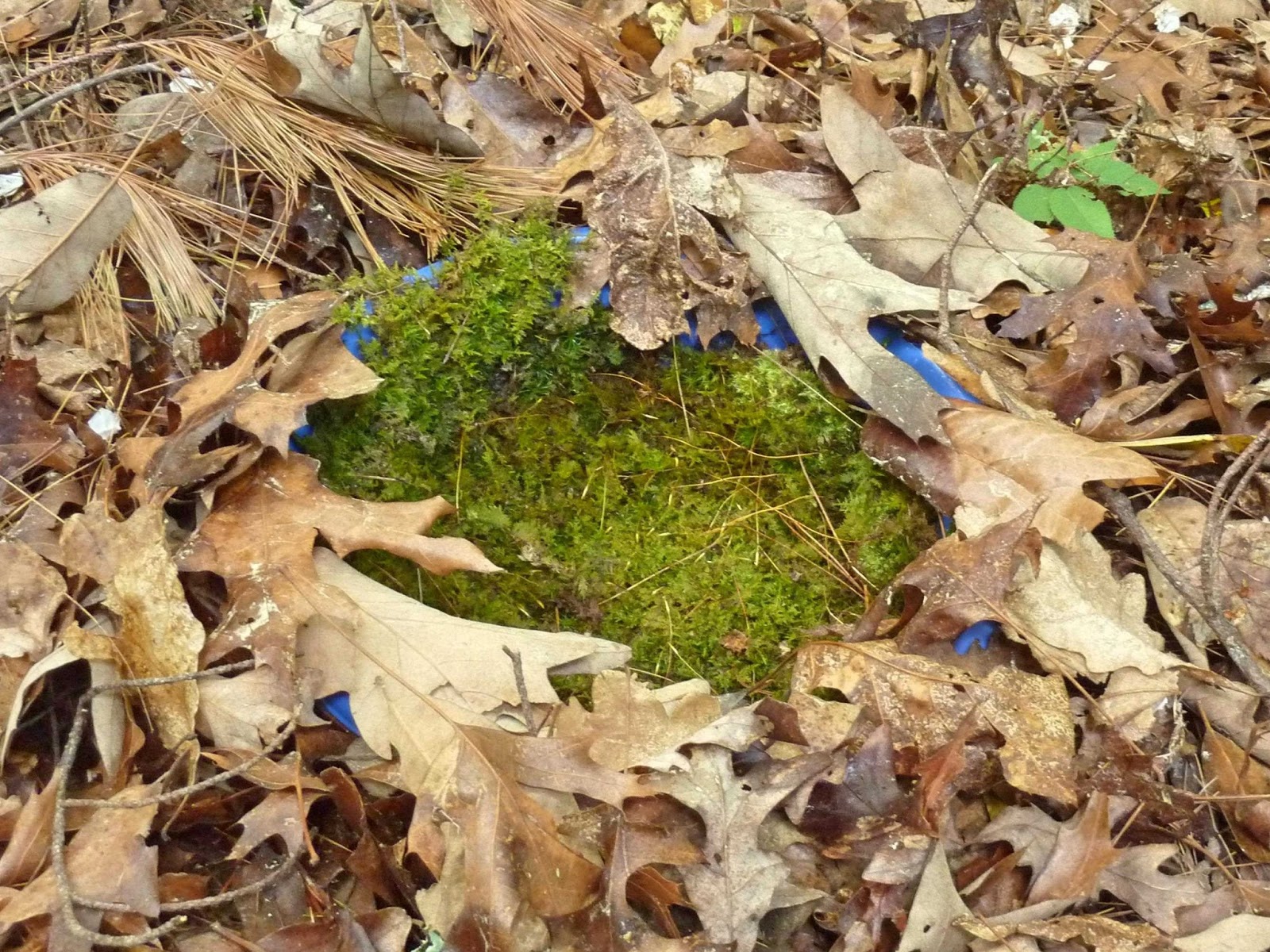
the photography was completed, I placed the bowl in the ground within an old
stump hole in the heavily shaded forest:
And then camouflaged the blue plastic with detritus:
The plan is to leave the bowl in the ground where it will
incubate in a natural Appalachian forest environment. Hopefully, the sphagnum
moss will live and grow in the bowl well enough to look like a moss-covered hollowed-out
stump and be good for small-animal photography.
Monday, April 13, 2015
Terror Lizards
One of my fav jokes when hanging out with my friends next
to the lake is to tell them, “Don’t turn your back on the water.” It’s an
African saying of gaily dressed people who live in mud-and-wattle
huts in crocodile country. I, of course, am far more sophisticated wearing drab
polyester in a trailer park and doing my best to turn as many trailers into
beer cans as possible. Heck, I don’t have to worry about stepping outdoors into
a flock of Terror Parakeets or Terror Muslims!
So, on this cloudy morn after breakfast, I stepped outside
to drink the last dregs of my first cup of coffee while standing on the banks
of the dinosaurian Orange Lake. One of the pair of moorhens that lives right
outside my door immediately spotted me, let out its worried cut-cut-cutting
call, and swam slowly away toward the more varied habitats to the east. I think
these moorhens have their nest at the east end of the levee that extends from
my lot, based on a false-wound theatrical ploy the two gave me last week. So, I
imagine the second moorhen was on the nest this morning.
No big deal, just a nice daybreak in cool weather without
the sun in my eyes, veg omelet in my stomach, and delicious coffee (ask me to
make you a cup some time) on my lips. Then I looked down at my feet at the lakeside
floating mat:
Good thing it’s only three feet long!
Sunday, April 12, 2015
ACT - Saarinen Preserve
Arthur and Phyllis Saarinen donated a 78-acre tract to
the Alachua Conservation Trust, a non-profit land conservancy, for conservation
purposes. Today was the preserve’s grand opening, attended by 30-40 people
including the Saarinens and ACT personnel Hutch Hutchinson and Mark Larson.
Now called the Saarinen Preserve, it has 2.6 miles of
trails open to the public, all of which are used for hiking, horseback riding,
and bicycling. I walked 2.3 miles of them today.
Preserve trails are well-worn and have been recently bush-hogged
to widths of 6-12 feet. Other trails connect into the Saarinen Preserve trails
from adjacent properties that have been developed by neighbors over the past
several years. I don’t know about the access policy for off-preserve trails,
but there are markers along the trails where they exit the preserve.
The property is almost entirely forested. There is a
small area adjacent to the parking lot dominated by planted slash pine in the
overstory and laurel oak and live oak in the understory. Most of the site is
cloaked in hammock vegetation dominated by laurel oak and live oak, with a
small area in the southeast having abundant sweetgum. The central and southern
parts of the preserve’s hammock also have longleaf pine and the remainder of
the site has loblolly pine mixed in with the hardwoods. Other species of upland
hammock trees are rare. I saw only one small Southern magnolia, one Southern
red oak, and a couple of mockernut hickories, but there are also a few small sugarberry
and winged elm trees. Interestingly, Carolina buckthorn (Rhamnus caroliniana) is common in the preserve’s southern reaches; I
see this shrub only rarely, so it was a treat. Ebony spleenwort is common.
Several species of invasive exotic plants also occur, Ardisia and camphor being
abundant in certain areas and Japanese climbing fern occasional. The Ardisia is
loaded with berries:
The soils are derived from the Miocene-aged Hawthorne
formation rather than the usual Plio-Pleistocene sands in this region. This does
not surprise me, however, because the preserve is on the same ridge that
Warrens Cave, Dead Man’s Cave, and Breath of the Rock Cave are located on and
they too have the dark Hawthorne clay soils. ACT representative Mark Larson
told me that every time they dug a hole for a fence post, they hit rock about
18 inches down and the rocks were boulders, not bedrock. What I can’t figure
out is how those boulders got themselves imbedded in the Hawthorne formation in
what Mark basically described as a layer of rocks. Curious, that.
It will be interesting to see what ACT comes up with in their
land management plan for the preserve. I imagine they will figure out how to
replace the laurel oaks with quality hardwoods. The cave properties mentioned
above indicate that the Saarinen Preserve historically supported a species-rich
mixed forest dominated by live oak, Southern red oak, Southern magnolia,
mockernut hickory, redbay, sugarberry, American ash, and winged elm, among many
others. But 78 acres of laurel oaks will be tough to battle!
Subscribe to:
Posts (Atom)