This 10cm sally was spotted on the exterior of a solar greenhouse at 3400ft msl in Henderson Co., NC, in mid-October this year. iNaturalist identified it as a Blue Ridge Two-lined Salamander (Eurycea wilderae). Note the dorsolateral lines fading into spots halfway along the tail for its specific id. Note the fabulous yellow of the belly for your admiration!
Dicromantispa interrupta
Mantisfly
Thursday, October 20, 2022
Monday, August 1, 2022
Need Engineering Trade Journals
I am a member of AAAS, and while that organization’s Science News articles written by its journalism staff are long on who did the research and where they work, their articles are sadly short on the nitty gritty. Fortunately, AAAS also publishes the journal Science, which minutely details cutting-edge research applicable to multiple research disciplines. Good mag, that.
I love to read about science and engineering. Science indeed feeds the former, but not the latter. A long-ago workplace’s engineers used to pass around engineering trade magazines, which discussed details of the latest applications in engineering research. I read them as avidly as my engineering colleagues (I am a wildlife biologist). I miss those mags.
One article in particular, I believe in a magazine entitled Civil Engineering, was written by an engineer who immersed a “hardware cloth” wire grid into saltwater and applied a small current to it. Over a month-long period, a hard solid that looked like cement subsequently “grew” on the grid. He initially suspected it was a marine salt precipitate, but after turning off the power, it did not redissolve. He didn’t want to pay for a chemical assessment, but opined that the material might have been some kind of hydrated compound. Because (I think) he used raw saltwater, I wonder if there might also have been a microbial component. Whatever, thinking that it had potential as a building material, he patented it and dedicated the patent to the public. The popular press would never, ever do articles like that.
More recently, there have been a series of vapid articles in the pop press about a Netherlands architectural firm designing a floating town for Mauritius. Its goal is to stay ahead of global warming’s sea rise. The new town’s buildings will be on rafting platforms joined together and anchored in place within an atoll. The architectural drawings are all pretty faces, of course, but neither pop press articles nor company PR detail such things as what materials comprise the floats, platforms, infrastructure, and buildings. Yawn. How are individual floating pods interconnected? With steel cables? With wooden beams? How will they deal with fouling organisms that glom onto and weigh down the floats? Seascaping projects like this one fascinate me, but all the articles I’ve read about it so far (and I’ve looked hard!) are empty calories to my analytical mind.
Or how about Elon Musk’s fantasy about a Mars colony? What EXACTLY does he plan to do about the physiological impacts to the human body from long-term exposure to low gravity? There’s not a peep about that issue in pop press articles. Hellooo! Earth calling Mars!
So, I plan to spend a little time over the next few weeks looking at engineering and architectural trade mags to see if they might take me where I want to go, and at what cost. Do any of you engineers and architects out there have any pointers? TIA
Monday, December 14, 2020
My Florida Torrey 2020 Status
Saturday, December 5, 2020
Solar Greenhouse Thermal Mass Hydroponics
Many greenhouses today use thermal mass water tanks. The 26 ft diameter Open Spaces Growing Dome solar greenhouse that I manage for a friend at 3400 ft elevation in western North Carolina has one that might hold about 600 gallons. Climate zone maps say it is within zone 7, but I believe it might as well be zone 6 at that elevation. Whatever.
I have asked around on Facebook's greenhouse and general gardening groups
whether anyone is using their thermal mass water tanks for hydroponic or aquaponic
cultures, and have received zero responses one way or the other. My suspicion
is that people who do so are doing it on a commercial scale, which is fine as
far as that goes. However, there are many greenhouse gardeners who grow for
their own and friends’ tables, so I think this represents a currently wasted
opportunity. If you have a thermal mass water tank in your greenhouse, or are
thinking about putting one in, consider adding edibles to those tanks. I don’t
think you will find very much directly applicable information out there (and I
could be wrong about that), but perhaps if we who do eat what comes out of our
tanks, we can share what we have learned in Facebook greenhouse and gardening
groups.
I started out by researching crops to grow on a small scale in the GH I manage. It turns out that there are few such crops, and many of them are invasive pests that can be illegal to grow; e.g., watercress (Nasturtium officinale), which grows rampantly in some of America’s natural streams. Other native wild species like yellow water lily (Nuphar advena) and wild rice (Zizania, four species) are too large and difficult to harvest from small water tanks. I uncovered no suitable aquatic plants, so I looked for wetland plants that might be grown on floats.
One of the most promising candidates is Chinese water chestnut (Eleocharis edulis). This is a small wetland plant that can be raised in shallow water in a matrix of organic mud (I don’t call it soil, as there is no such thing as a true wetland “soil”). I obtained ten corms of it from a nursery in Florida, then punched five half-inch holes in the bottom of a closed-cell foam packing tray and placed five corms in the holes equally spaced around in the tray:
I then added the other five corms and filled the tray with about two inches of organic mud. They took their sweet time to sprout and then grew relatively slowly, averaging maybe 14 inches in height by early July 2020 (week 13):
As of last week (week 31), some of the leaves had grown to a height of about 16 inches and had started to die back for the winter. I do not know if the original corms have budded new ones, as this is not obvious. They may have stored enough energy during this past growing season to add more corm/shoot growth in the coming spring, and I don’t want to retard that possibility by disturbing them now just prior to winter. About half of the mud is gone, presumably by decomposition, but possibly also by percolating down into the tank through the watering holes. I plan to add more mud during early springtime. In the photo, note the plants’ white roots floating just under the water’s surface:
There are a few small fish (unknown species) in the tank to keep mosquito larvae at bay. I was afraid the fish might eat the roots, but that does not seem to be a problem. There is a thick layer of algae growing atop the mud, and I wonder if it will adversely affect the plants, but that remains to be seen.
Despite the water chestnut’s slow growth, I was encouraged by the successful proof of concept, wherein the floating wetland bed remained afloat, the water chestnuts flourished, the mud acted as a wetland substrate, and nothing bad happened over the five-month experiment. However, further internet searches turned up no other suitably promising floating wet mud crops, so I turned my attention to drier floating substrates, and it being autumn becoming winter, settled on peas - specifically snow and sugar snap peas. I had already successfully raised those in outside beds nearby, so I knew they would work with the potting soil that was available.
This time, I used Styrofoam packaging material, again punched half-inch holes in the bottom for irrigation, and placed 1- to 2-inch rocks above the holes to elevate the potting soil above the water level and hopefully to keep most of the dirt from dropping through the holes. This is what it looked like one week after planting (late September 2020):
The pea seeds fairly leapt up out of the ground! Over the following weeks, the plants (vines) grew eight inches up and over the edge of the tank, another four feet down to the greenhouse floor, and then back up another two feet. That’s almost seven feet over 11 weeks, which was easily twice the length of pea vines grown outside in the garden bed during the summer. I don’t know if they grew faster in the greenhouse because peas are a cool season crop, but I also must admit that they have yet to flower and set seed. There could be a nutrient deficiency in the water tank, but that is hard to determine because water nutrient analyses are expensive and the county extension agency is oriented toward determining fertilizer levels in dirt, not water.
Tuesday, March 19, 2019
Red Wolves?
Sunday, December 23, 2018
A Solar Greenhouse to Play In!
The ventilation fan also works well; however, I am a bit
confused about its thermostat. Currently, the fan turns on and blows outside
air into the GH when inside air temperature drops to about 65 °F,
and then turns off when greenhouse air rises to 80+ °F. That is obviously backwards
from what it should do, and the manufacturer confirmed to me that the
thermostat was probably wired backwards, but after reversing the thermostat’s
internal wiring based on a diagram he sent me, it still turns on and off
backwards. Maybe I only thought I rewired it correctly but actually didn’t? I’ll
revisit this in the spring, but the fan is now disabled and shuttered for the
winter.humus and very little Perlite).
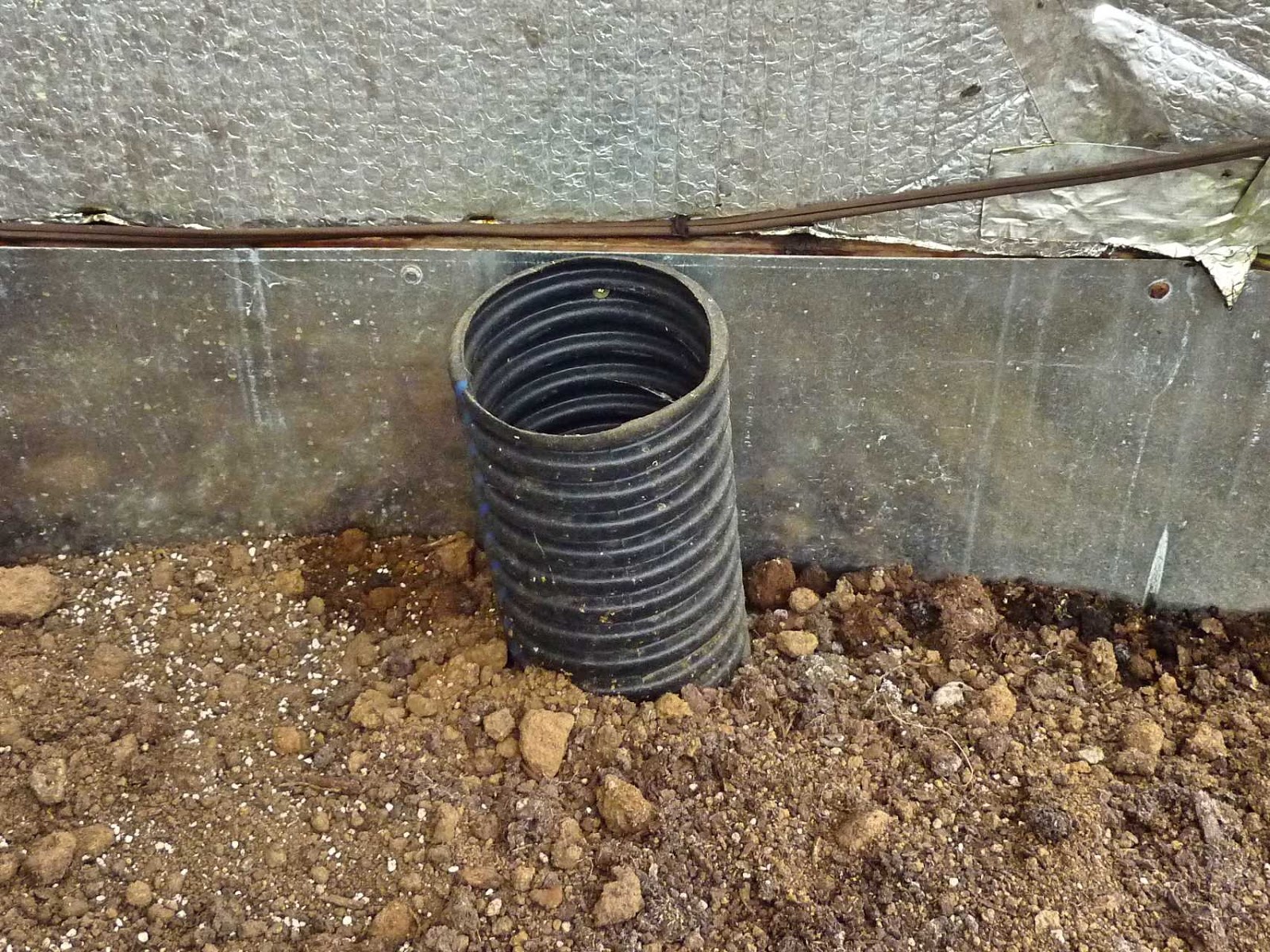
There are two four-inch diameter ribbed plastic pipes running the entire length of the perimeter beds at the interface between the native dirt and potting soil. The pipes lead from an air intake box near the center of the GH’s south side (the warmest place in the GH):
The water tank's bilge pump was seized up when I came on board, so it was discarded but not replaced. My friend said it never worked (!) and she didn’t miss it, so there are no plans to replace it. The electric wires from its solar panel are still in place but not connected to anything. I harbor thoughts of eventually installing a new bilge pump and using the water tank (pictured below) for more than just thermal storage, but that is a subject to write about on another day. In the spring of 2019, I plan to move the bilge pump’s solar panel to the southwest side of the roof and the soil heater solar panel to its southeast side. I will then wire the two solar panels in parallel to power the soil bed heating fan, which together should provide power for a longer diel period and heat the raised bed soils even better than originally designed.
(2) the SW ventilation panel was never completely closed
because the hose was kept there, causing warm greenhouse air to escape to the
outdoor winter environment, and (3) the spigot was destroyed twice in freezing weather
after being left on due to forgetfulness. I convinced her to let me and her
handyman move the spigot to the inside of the greenhouse, which was done in
December 2018, and I then attached a four-way brass water distributor (and a
plastic wye) to it to provide five protected tap water sources inside the
structure.
Next, I connected two soaker hoses to the distributor.
For the short raised bed located along the greenhouse’s west side and beyond
the door, I cut a short section from a garden hose, added male and female
connectors to the severed hose ends, and ran the short hose to the short bed to
connect into a 25 ft long soaker hose. This photo shows the hose running
vertically along both lower sides of the door (the hose is also buried four inches
under the floor sand).
We have also had to learn a lesson in varmint control. The
entire floor of the structure is underlain by eighth-inch wire mesh to prevent
rodents from burrowing into the greenhouse. This includes under the raised
beds, as mentioned above, and under the central floor’s four-inch-thick layer
of coarse sand. However, today I spotted on the bottom of the water tank a
drowned mouse that evidently fell in and could not climb out. We had been
wondering what was eating the leaves of the parsley and red Russian kale, and were advised by neighbors that it was probably slugs,
so we were planning to install beer traps. However, the mouse could also be the
culprit, as a cursory search has yet to turn up a single slug and there are
still many holes in the walls that need to be plugged. What do you think?