Stop me if I’ve told you this story. But first, I gotta tell you that I was reminded of it by a wonderful blog I just discovered written by Lynda, called Mainly Mongoose. Absolutely, you must check out her posts (http://mainlymongoose.blogspot.com/), especially the last two or three about lions and elephants, which precipitated this posting.
I was 15 years old and living in a trailer on the Westside of Jacksonville, Florida on the very outskirts of town near Cecil Field, a Navy base. By outskirts, I mean that beyond our little trailer and clapboard neighborhood there was nothing but pine flatwoods, cypress and gum swamps and blackwater creeks. It was a fine place for young male hellions such as my friend Danny and I, ‘cuz there were plenty of snakes and bream to catch and bobcats to watch zinging across dirt roads at night in front of headlights. I don’t believe that I have ever before or since lived in a more wildlife-abundant place.
One of the neighborhood fathers had constructed a treehouse in the flatwoods not too far from where we all ordinarily slept, and it was palatial as far as most treehouses go. No, it wasn’t a Disneyesque Swiss Family Robinson McMansion, but it beat the pulp out of any other treehouse I ever got to play in. The man had found four stout pines growing in almost a perfect square, and had built a 6-sided wooden box about 8 ft off the ground among them. It had 4 walls, a door and 3 windows in addition to the requisite floor and roof. The walls were lapboard and the plank roof was covered with roll roofing (rock-covered asphalt felt). The door could be latched from inside as could the storm-shuttered windows. He was a good father.
The event happened on the first night we camped out in it, natch! Some of the kids didn’t have sleeping bags and it was cold, so they brought carpets to roll up in. I am not joking about the carpets – this was not an affluent neighborhood. We had a little campfire downstairs and cooked up some marshmallows and hot dogs before turning in. Boy, were we cool! No parents were present to lord it over us and we were sooooo confident in our independence. Of course, all the neighborhood dogs were present too. Hey, they were not about to miss a campout with kids and weenies!
As the evening wore on, we got sleepy and decided it was time to lay our heads down, so up the ladder we went and settled in for a good night’s sleep. The dogs were made to stay below to “guard” us, a job they took seriously, I’m sure. We battened down the hatches by closing and latching the door and shutters, said our prayers, chattered for a few more minutes, and then as the little ones drifted off, we elders shut up and lay awake listening to night sounds. There were katydids, tree crickets, nighthawks and chuck-will’s-widows sounding off for the evening, and all was really quite peaceful and well with the world.
Suddenly, the dogs started barking. At first, they only barked curiously, alertly, but after a short time began barking in a more worried timbre. This soon segued into a fearful, whiny barking that subsequently evolved into out-and-out yelping, and the next thing we knew the dogs were haulin’ ass outta there, crying in complete fear as they ran and stumbled, probably not even looking back. We heard them disappear into the distance as each one found its own way home, every dog for itself.
Gulp! It was a pitch black night with no moon, and it was even darker inside the treehouse. Every kid in there had platter-eye syndrome. No one was asleep. The little kids were muttering and whimpering quietly, and quite frankly, the hair on the back of my neck stood on end for the first time in my life. One of the little kids then mustered, “Buford, look outside and see what it is!” “Right,” I thought, “you would pick me.” But I was the oldest and nearly a man, so I knew that was right. OMG megagulp! I quietly slipped out of my sleeping bag, fumbled around and found my flashlight, slunk over to one of the shuttered windows and slowly opened one side of it, put the flashlight on top of my head so that the tapetum lucidum in the intruder’s eyes would reflect back at me, and panned the ground around.
And then I saw it, or rather saw them, a pair of eyes looking back at me from perhaps 20 ft away. They were about a half-inch in diameter, appx 3 inches apart and perhaps a foot off the ground. Then they disappeared and I slammed the shutter shut! And latched it. The beast neither tried to climb the stairs (as far as we knew) nor did it ever make a sound and we saw nothing of it any further that night or otherwise. To this day, I do not know for sure exactly what I saw, but firmly believe it could only have been a Florida panther.
The treehouse was dismantled the very next day, and we were never again allowed to camp overnight in those flatwoods.
Dicromantispa interrupta

Mantisfly
Sunday, August 22, 2010


Saturday, August 21, 2010
The Botanical Gardens at Asheville
I just discovered this wonderful place on the local campus of the University of North Carolina. Why is it such a great place? Let me count the ways…
The parking lot is in two sections, one being small and tree-shaded and the other being a sunny overflow area. There were only a few vehicles other than mine, so I was able to park in the shade – a nice touch.
Going into their gift shop before seeing the gardens proper, I met a nice lady volunteer who immediately pointed me to their book section. I wanted a book on NC wildflowers because I had earlier found a blooming roadside vine that my Southeastern wildflower book didn’t have, and figured that, as long as I was going to be spending a lot more time in NC, I needed a local flora book. They had several, so I bought Justice, Bell and Lindsey’s Wildflowers of North Carolina. Much to my chagrin, it did not have the plant I wanted identified, but out of the back rooms came Jake, a local naturalist who was able to finger the plant and also gave me a personal tour of some of the resources at the headquarters.
It turned out that the plant is Clematis terniflora, an invasive exotic from Asia. Jake related some growth and kill-attempt experiments he had done on the plant, and folks, it’s bad. You almost can’t kill it and it grows faster than kudzu! Cry your eyes out over this beauty:
Anyway, off I went with my new book under my arm to tour the place, and it was with sublime joy that I discovered that this botanical garden is totally dedicated to native plants. There were coneflowers, sunflowers, Solomon’s and false Solomon’s seals, at least 3 kinds of violets, blue curls, cardinal flower, and numerous species of shrubs and trees. Most of the flowers were in my new book, so I was able to read about them and compare the pictures to the real things!
Blessedly, there were more identification labels on the plants than I have seen at any botanical garden in any of my travels. Each label had the common and scientific names plus family names. Many of the more common plants were identified by several labels scattered throughout the garden so that, if I forgot a name, and I did, I was able to see it again and sometimes again and again.
And it wasn’t as if they had only a few specimens of each plant. Oh no! They often had hundreds of each species and the beds are packed with them, although some of them were indeed rare. In most botanical gardens, rare plants are kept unlabeled and in inconspicuous places where you wouldn’t ordinarily look for them to protect them from thieves. Well, I am sure they did some of that, too, but a few rare species were prominently displayed and labeled, and furthermore, when a roving gardener saw me paying special attention to one plant that shall remain unnamed, he (ahem) obviously recognized that I was a special person and sidled up to me to tell me about some more rare plants that he knew I might otherwise miss. What a nice man.
In deference to protection of the rare flora, I shall relate only one of those, Franklinia alatamaha, a plant that I have been looking for all my life, and now that I am 62 I have finally gotten to feast my eyes on it, say Hallelujah!!! I know of a few other botanical gardens where it supposedly occurs, but it was always hidden when I visited. Franklinia was discovered by John and William Bartram in 1765. William retrieved seeds in 1777, germinated and brought them to flower and named the genus after Benjamin Franklin. William remarked that he never saw it growing anywhere but the original 2- to 3-acre site where he and John had found it. Its last verifiable sighting in the wild was in 1803, and all the specimens in the world are descendants of the seeds collected by William Bartram. It is said to be commercially available, but I have asked about it in maybe a hundred plant nurseries throughout the Southeast but have received only blank stares in return. So please, kind folks, if any of you know where I can score some nursery stock, run don’t walk to your emailer and inform me! Oh, incidentally, not only did I get to see the beast, it was in flower and I got a decent photo of it:
I can die now.
The parking lot is in two sections, one being small and tree-shaded and the other being a sunny overflow area. There were only a few vehicles other than mine, so I was able to park in the shade – a nice touch.
Going into their gift shop before seeing the gardens proper, I met a nice lady volunteer who immediately pointed me to their book section. I wanted a book on NC wildflowers because I had earlier found a blooming roadside vine that my Southeastern wildflower book didn’t have, and figured that, as long as I was going to be spending a lot more time in NC, I needed a local flora book. They had several, so I bought Justice, Bell and Lindsey’s Wildflowers of North Carolina. Much to my chagrin, it did not have the plant I wanted identified, but out of the back rooms came Jake, a local naturalist who was able to finger the plant and also gave me a personal tour of some of the resources at the headquarters.
It turned out that the plant is Clematis terniflora, an invasive exotic from Asia. Jake related some growth and kill-attempt experiments he had done on the plant, and folks, it’s bad. You almost can’t kill it and it grows faster than kudzu! Cry your eyes out over this beauty:

Anyway, off I went with my new book under my arm to tour the place, and it was with sublime joy that I discovered that this botanical garden is totally dedicated to native plants. There were coneflowers, sunflowers, Solomon’s and false Solomon’s seals, at least 3 kinds of violets, blue curls, cardinal flower, and numerous species of shrubs and trees. Most of the flowers were in my new book, so I was able to read about them and compare the pictures to the real things!
Blessedly, there were more identification labels on the plants than I have seen at any botanical garden in any of my travels. Each label had the common and scientific names plus family names. Many of the more common plants were identified by several labels scattered throughout the garden so that, if I forgot a name, and I did, I was able to see it again and sometimes again and again.
And it wasn’t as if they had only a few specimens of each plant. Oh no! They often had hundreds of each species and the beds are packed with them, although some of them were indeed rare. In most botanical gardens, rare plants are kept unlabeled and in inconspicuous places where you wouldn’t ordinarily look for them to protect them from thieves. Well, I am sure they did some of that, too, but a few rare species were prominently displayed and labeled, and furthermore, when a roving gardener saw me paying special attention to one plant that shall remain unnamed, he (ahem) obviously recognized that I was a special person and sidled up to me to tell me about some more rare plants that he knew I might otherwise miss. What a nice man.
In deference to protection of the rare flora, I shall relate only one of those, Franklinia alatamaha, a plant that I have been looking for all my life, and now that I am 62 I have finally gotten to feast my eyes on it, say Hallelujah!!! I know of a few other botanical gardens where it supposedly occurs, but it was always hidden when I visited. Franklinia was discovered by John and William Bartram in 1765. William retrieved seeds in 1777, germinated and brought them to flower and named the genus after Benjamin Franklin. William remarked that he never saw it growing anywhere but the original 2- to 3-acre site where he and John had found it. Its last verifiable sighting in the wild was in 1803, and all the specimens in the world are descendants of the seeds collected by William Bartram. It is said to be commercially available, but I have asked about it in maybe a hundred plant nurseries throughout the Southeast but have received only blank stares in return. So please, kind folks, if any of you know where I can score some nursery stock, run don’t walk to your emailer and inform me! Oh, incidentally, not only did I get to see the beast, it was in flower and I got a decent photo of it:

I can die now.
Tuesday, August 17, 2010
Fathers and Daughters
I’m in a frisky mood tonight and I just ran across a blog post about a father-daughter day, so I was reminded of a fathers-and-daughters story of my own. FAIR WARNING!!! This one is not for the easily offended (but it is about nature).
Picture us on a company field trip. We performed biology field work in a miserably cold winter wind all day long. We were windburnt, poison ivied, dehydrated, hungry and just plain whupped from the cold and the rough terrain. All day long we had used hand clippers on our hands and knees to tunnel through greenbriar and poison ivy thickets rather than hack our way with machetes. We were really very tired and stupid by evening, so you can hopefully understand our slowness to comprehend things. You should also know that the city was a coastal tourist town, and the biggest convention there that day was one for new-car dealership owners. Thus, there were a lot of lonely, middle-aged, rather affluent men in town without their wives. Got the picture?
Stupefied, we returned to the hotel that evening, showered and stumbled downstairs to the hotel restaurant below for dinner. We ordered our food and were having before-dinner drinks on our client’s dime, and I’m not talking about iced tea. Of course, that made us even stupider, but what’s your point? Cindy glanced over at the table next to us and noticed that there was a pair of beautiful young women sitting with a pair of fat, middle-aged men, and she said, “Oh look, there’s a couple of fathers and daughters having dinner together!” The rest of us discretely looked over at the foursome and allowed as how, yes, they did make a nice pair of fathers and daughters, and then returned to our own conversation and libations.
But something nagged at me a bit about the scene, so I looked again and saw one of the women lightly slap the hand of one of the men that had gone where it shouldn’t have gone in a restaurant, and it was then that I noticed that the dining room was filled, literally filled with “fathers and daughters.” I kid you not, that room had a hundred alluring, fetchingly dressed young women sitting with a hundred fat, middle-aged new car dealers, and with the glee that only a 25yo tipsy bachelor can muster, I pointed this out to my group. The look on Cindy’s face as she realized what was really going on was absolutely priceless – a kind of a shock that turned to horror that eventually relaxed into exuberant humor!
Myrtle Beach, Virginia sure has a lot of starlets.
Saturday, August 14, 2010
Chassahowitzka Swamp in August
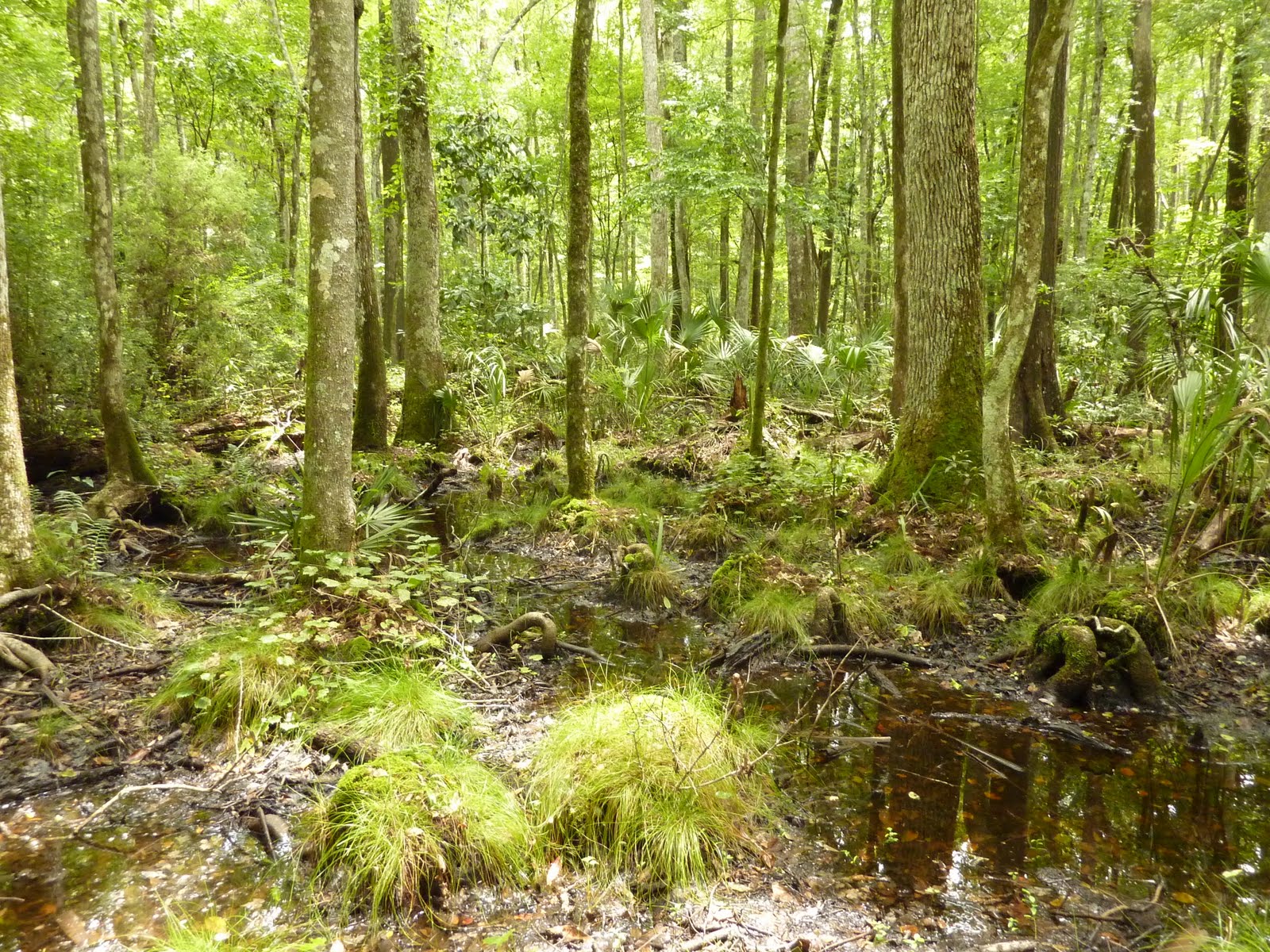
I couldn't raise the troops for a trek into the Chazz Swamp, so I went there solo on Saturday. It's about a 1:45 hour drive thanks to all the schlocky podunks from Inglis on south to just north of Thresher Road where one turns west to enter the Chazz WMA. The limerock road you turn into is actually named Indigo Road, but there is no sign for that at US 19. I paid my three bucks and drove on in. The goal was to get an idea of the terrain north and east of where I have been before, to check out the so-called Sink 311A that was named by some cave diver and to look for more karst features yet unknown to me. Here is what my 5.1-mile dayhike looks like on Google Earth:
Some of my buddies have the idea to camp out in the swamp while on a 2-day wander around the place. I tried to convince them of their folly but they just called me a wuss. Harumph! These photos, which are typical in every way of the Chazz Swamp, should convince anyone that camping there in tents and sleeping bags is an odd idea.


But there are some neat things to see there, like cabbage palms cloaked with shoestring fern (Vittaria lineata).
And a view of the clear waters of Blind Creek with snags and three young alligators sunning themselves.
And Pool 8 (dunno its Christian name), with its limestone ledge above a sheer drop into cool, deep water.
And this pair of unidentified blue mushrooms that have emerged from below thick leaf litter to look like alien blue eggs in a cupped nest.
People talk all the time about cypress knees and debate what their function is, but I am just as pleased at the knees of other tree species like swamp tupelo (Nyssa sylvatica var. biflora) and sweetgum (Magnolia virginiana).
Did you notice the deer bones scattered to the right of the knees? I did not notice them until stooping down to snap the shot.
There was plastic flagging everywhere I went out there, red, orange, blue and candy-striped, plus three plastic balloons. So much for wilderness! OTOH, there was very little sign of feral pigs, perhaps because there is so little food for them this time of year. Other interesting biota seen included a striped mud turtle (Kinosternon bauri), beau coups corkwood plants (Leitneria floridana) and a terrestrial Habenaria orchid, possibly H. odorata, which we have seen blooming out there before.
Lastly, the prescribed burns that the State is conducting in the pine flatwoods and sandhill habitats are doing great things! Oaks and slash pines are being killed back, allowing for an abundance of ground plants for gopher tortoises to feed on. The burns will eventually result in a greater abundance of the large-seeded longleaf pine. Many of the herbs are in bloom and support diverse pollinators, and the longleafs will provide sustenance for the threatened fox squirrel. Gopher tortoise burrows were abundant, and goldenrod provided great swaths of cheerful color. I didn't even mind that I was soaked in perspiration and swamp water by the time I returned to the truck.

Some of my buddies have the idea to camp out in the swamp while on a 2-day wander around the place. I tried to convince them of their folly but they just called me a wuss. Harumph! These photos, which are typical in every way of the Chazz Swamp, should convince anyone that camping there in tents and sleeping bags is an odd idea.




But there are some neat things to see there, like cabbage palms cloaked with shoestring fern (Vittaria lineata).

And a view of the clear waters of Blind Creek with snags and three young alligators sunning themselves.

And Pool 8 (dunno its Christian name), with its limestone ledge above a sheer drop into cool, deep water.

And this pair of unidentified blue mushrooms that have emerged from below thick leaf litter to look like alien blue eggs in a cupped nest.

People talk all the time about cypress knees and debate what their function is, but I am just as pleased at the knees of other tree species like swamp tupelo (Nyssa sylvatica var. biflora) and sweetgum (Magnolia virginiana).

Did you notice the deer bones scattered to the right of the knees? I did not notice them until stooping down to snap the shot.
There was plastic flagging everywhere I went out there, red, orange, blue and candy-striped, plus three plastic balloons. So much for wilderness! OTOH, there was very little sign of feral pigs, perhaps because there is so little food for them this time of year. Other interesting biota seen included a striped mud turtle (Kinosternon bauri), beau coups corkwood plants (Leitneria floridana) and a terrestrial Habenaria orchid, possibly H. odorata, which we have seen blooming out there before.
Lastly, the prescribed burns that the State is conducting in the pine flatwoods and sandhill habitats are doing great things! Oaks and slash pines are being killed back, allowing for an abundance of ground plants for gopher tortoises to feed on. The burns will eventually result in a greater abundance of the large-seeded longleaf pine. Many of the herbs are in bloom and support diverse pollinators, and the longleafs will provide sustenance for the threatened fox squirrel. Gopher tortoise burrows were abundant, and goldenrod provided great swaths of cheerful color. I didn't even mind that I was soaked in perspiration and swamp water by the time I returned to the truck.
Sunday, August 1, 2010
Swimmin' with 'gators and spiders, oh my!
Ok, lately I HAVE been having fun. One recent afternoon included swimming in a swamp braid of the Wekiva Spring Run where it crosses CR 326 in Levy County. A quick look at the situation where some of my buds were cooling off will give you an idea of the place:

Of course, you have to be totally unafraid of alligators and cottonmouths to swim here. Bruce, Bill, Jon and I did so, but Lisa deferred. Um, you also should be unafraid of giant spiders:
That tree it is on is appx 4.5 inches thick. Trying to id the beast, I found a site that has several fishing spider photos and the similarities are great. Thus, I think it is a Dolomedes in the family Pisauridae, otherwise known as fishing spiders, probably neither D. albolineatus, the white banded fishing spider nor D. triton. I found a video of a D. okefinokensi adult female, but the abdominal dorsal pattern is wrong and their femme does not have a white perimeter band:
http://www.youtube.com/watch?v=y1p8bx374nM.
Pesce on SpiderIdentification.org suggested it might be D. tenebrosus. Their pic, of a male, is very similar but does not have the white perimeter around the central black spot on the cephalothorax that ours has. That could be explained by gender difference or by individual variation? Unfortch, a bugguide.com range map does not depict it as being in Florida, but that map is obviously gappy. Various web sites claim it is North America’s largest spider. Davesgarden.com (http://davesgarden.com/guides/bf/showimage/2447/) has a bunch of D. tenebrosus pics, but all show brownish specimens without the white perimeter band. Our specimen is grayish.
The NC website has a pic of Dolomedes scriptus, and it is almost a dead ringer for our octopedded monster, except that theirs is a little browner and has a less obvious white perimeter band around the dorsal black spot:
http://www.carolinanature.com/spiders/spider2624.jpg. OTOH, the Wikipedia entry for that species depicts and describes a white stripe down the sides of the animal, in full conflict with the Carolina site. Egad! Will the real D. scriptus please stand up!
Interestingly, fishing spiders crouch on top of the water with the two hindmost legs anchored to a floating leaf or whatnot, and then plunge downward into the water while still holding onto the leaf to grab their prey, usually a fish or invertebrate, but I bet they will also take small frogs as their African relative, Ancylometes rufus, is shown to do in this video: http://www.youtube.com/watch?v=zv7YSEIOxwo&feature=fvw. Male fishing spiders are known to tie up the females with silk prior to mating. Hey, bondage is what I’d do if my ladies were bigger and hungrier than me!


Of course, you have to be totally unafraid of alligators and cottonmouths to swim here. Bruce, Bill, Jon and I did so, but Lisa deferred. Um, you also should be unafraid of giant spiders:

That tree it is on is appx 4.5 inches thick. Trying to id the beast, I found a site that has several fishing spider photos and the similarities are great. Thus, I think it is a Dolomedes in the family Pisauridae, otherwise known as fishing spiders, probably neither D. albolineatus, the white banded fishing spider nor D. triton. I found a video of a D. okefinokensi adult female, but the abdominal dorsal pattern is wrong and their femme does not have a white perimeter band:
http://www.youtube.com/watch?v=y1p8bx374nM.
Pesce on SpiderIdentification.org suggested it might be D. tenebrosus. Their pic, of a male, is very similar but does not have the white perimeter around the central black spot on the cephalothorax that ours has. That could be explained by gender difference or by individual variation? Unfortch, a bugguide.com range map does not depict it as being in Florida, but that map is obviously gappy. Various web sites claim it is North America’s largest spider. Davesgarden.com (http://davesgarden.com/guides/bf/showimage/2447/) has a bunch of D. tenebrosus pics, but all show brownish specimens without the white perimeter band. Our specimen is grayish.
The NC website has a pic of Dolomedes scriptus, and it is almost a dead ringer for our octopedded monster, except that theirs is a little browner and has a less obvious white perimeter band around the dorsal black spot:
http://www.carolinanature.com/spiders/spider2624.jpg. OTOH, the Wikipedia entry for that species depicts and describes a white stripe down the sides of the animal, in full conflict with the Carolina site. Egad! Will the real D. scriptus please stand up!
Interestingly, fishing spiders crouch on top of the water with the two hindmost legs anchored to a floating leaf or whatnot, and then plunge downward into the water while still holding onto the leaf to grab their prey, usually a fish or invertebrate, but I bet they will also take small frogs as their African relative, Ancylometes rufus, is shown to do in this video: http://www.youtube.com/watch?v=zv7YSEIOxwo&feature=fvw. Male fishing spiders are known to tie up the females with silk prior to mating. Hey, bondage is what I’d do if my ladies were bigger and hungrier than me!
Monday, July 12, 2010
Wildlife Marking Trees
As you can clearly deduce from the lack of recent postings to this blog, I just haven’t been having much fun lately. Oh well, I guess I’ll just have to synopsize an article recently published in the summer 2010 issue of the Wildlife Professional, which is the non-technical quarterly read of The Wildlife Society. The article is entitled “How animals send ‘tree mail.’” If the Camera Codger and Henry, two camera trappers that I greatly admire still read my blog, they and other camera trappers should pay special attention.
Cam McTavish and Michael Gibeau have written a marvelous piece about trees that are used by wildlife as marking posts to inform other animals about their presence. Their research was based on >16,000 camera-nights, plus winter-time tracks in the snow. As a result, these fellows have uncovered a hitherto unknown galaxy of behavior and camera trapping opportunities. As you all know, many species of mammals mark certain trees as a way to alert conspecifics (same species) and other species of their presence. It can be done to mark territorial boundaries, scare away competitors and advertise their physical prowess and sexual state, among other things. Here's a black bear-marked cabbage palm tree I photographed somewhere (I forget) that has some pretty deep claw marks:

Surprising to me, however, is the relatively large number of ways that mammals use to mark trees. This includes biting and scratching by bears; scratching the ground around the trees by canids and felids; rubbing the bark by the mountain goat, bears and wolverine; defecation adjacent to and up to 20+ meters away by canids and felids; and spraying or rubbing of anal matter by the wolverine and felids.
Their list of marking species reads like a who’s who of mammalian predators, including grizzly bear, black bear, gray wolf, coyote, red fox, Canada lynx, cougar, wolverine, dog and martin. They also found a fair number of herbivorous species using marker trees: mule deer, white-tail deer, moose, elk, bighorn sheep, mountain goat, red squirrel, wood rat and porcupine. Other research has shown that many other species from bumblebees to hyenas worldwide use scent marking on trees. Feral pigs commonly rub trees around these parts.
We have all seen trees and shrubs marked by claws, antlers and hair, and I have always thought such tree mail was aimed at their own species, but this is emphatically not so! Using camera traps, they documented that marks by grizzly bears caught the attention of mountain goats, for instance, some of whom then also marked the tree, and mule deer will go well out of their way to investigate scent markings. Some marked trees were used by up to seven species.
Any species or size of tree can be marked. Age, girth and bark roughness of the trees make no difference. They are typically found beside animal and human trails and along fire lanes, power line ROWs and, get this, seismic lines! Although aspect (facing direction) makes no difference, they are usually on the downhill side of the trail. Most commonly, communication trees are at trail junctures where many species would tend to cross paths.
In most cases, predators actively used (marked) the trees whereas prey species used them only passively (sniffing). Obviously, predators want to advertise themselves to and fend off other meat-eaters while prey animals just want to learn which killers have recently passed by and might be nearby threats.
Other interesting characteristics of active users are:
-) Scent marks are often made by individuals that are dominant over and tolerant of conspecifics.
-) Scent marking can synchronize menstruation in females of a species.
-) Scent marking affects socio-sexual behavior and conspecific fertility, thus possibly reducing aggressive encounters.
-) Because small species of felids scent mark primarily when they are sexually active, fertility may be suppressed when their populations are high.
-) The variety of methods used for marking (paws, claws, scent, hair, etc.) may pass on other messages besides the obvious ones like “I am here” and “I am looking for love.”
McTavish and Gibeau also point out that some marker trees have been used for generations, up to 150 years for bear in one instance, and conclude that the loss of these special trees might have adverse effects that have been overlooked. For example, such trees might be terrific locations to conduct long term wildlife research, or their loss might cause additional inter- and intraspecific confrontations among local wildlife. All I know is that when my favorite stores go out of business, I am as lost as a lizard on a piece of driftwood sailing out to sea. So we might want to sleuth them out and try to save them from the land manager’s chain saw, although I don’t think I’d want to chain myself to a predator attractor!
Remind me to tell you some day about Richard and the black bear rub tree on Mormon Branch in Florida’s Ocala National Forest. It’s a hoot.
Friday, May 28, 2010
Onions are a Jones
I love to putter around in the garden just about as much anything. It is so good for the soul, this creation of food from "first principles." Weeds don't have a chance under the gaze of this gardener, although I transplant some of them to more appropriate places. Today I noticed that my grocery store ginger root had sprouted more roots plus shoots. Some folks would just throw it out, but a gardener will consider this a second bite at the apple. So into the garden it went, taking me only about 2 minutes to walk out and back and plant the little sucker. Maintaining a garden after it is set up is easy, taking only an hour or two a week to do the job including harvesting. Mother Garden nurtures me even when I'm on away missions, by provisioning me before the trip and chugging along in my absence. Here are my May harvests, ex radishes and snap beans that got eaten before photoed. Not a lot carbs, I'll admit, but maybe someday people will say, "Buford really knows his onions!"


Subscribe to:
Posts (Atom)