Dicromantispa interrupta

Dicromantispa interrupta
Mantisfly

Sunday, December 23, 2018

A Solar Greenhouse to Play In!


I have been helping a friend repair and put back into operation a 26 ft diameter geodesic dome solar greenhouse that was designed and sold by Colorado-based Growing Spaces.

She bought the greenhouse over ten years ago as a way to get her family to spend quality time together on a project. Her family scattered to the four winds over the years, and not having a green thumb she just ‘let it go.’ More recently, she decided to rehabilitate it as a way to grow her own organic veggies and provide a place for herself and her Buddhist group to meditate. I constructed a solar greenhouse in the late 1970s that followed the guidelines of the New Alchemy Institute (now called The Green Center), so now I get to play in a solar greenhouse again after all these years!

My friend flatly refuses to employ power from the local utility (Duke), instead relying on three small solar panels that came with the greenhouse: (1) a 12" x 24" panel powering a ventilation fan, (2) a 12" x 24" panel powering an under-soil heating system, and (3) a 12" x 12" panel powering a (bilge) pump intended to circulate water in the thermal storage tank. All three solar panels function fine and provide appx 12 vDC current, which obviously varies according to the amount of solar insolation available during the diel cycle as modified by weather.

The ventilation fan also works well; however, I am a bit confused about its thermostat. Currently, the fan turns on and blows outside air into the GH when inside air temperature drops to about 65 °F, and then turns off when greenhouse air rises to 80+ °F. That is obviously backwards from what it should do, and the manufacturer confirmed to me that the thermostat was probably wired backwards, but after reversing the thermostat’s internal wiring based on a diagram he sent me, it still turns on and off backwards. Maybe I only thought I rewired it correctly but actually didn’t? I’ll revisit this in the spring, but the fan is now disabled and shuttered for the winter.

The greenhouse’s two-foot-high internal raised beds are enclosed by concrete block walls, at the bases of which are layers of eighth-inch wire mesh (so-called ‘hardware cloth’) to ward off burrowing rodents. The beds encircle the greenhouse interior perimeter except at the door and water tank. The bottom halves of the beds are filled with native dirt, which is a rocky sandy clay that provides good enough drainage. The top halves of the beds are filled to an appx twelve-inch depth with potting soil (mostly pine bark with a little
humus and very little Perlite).


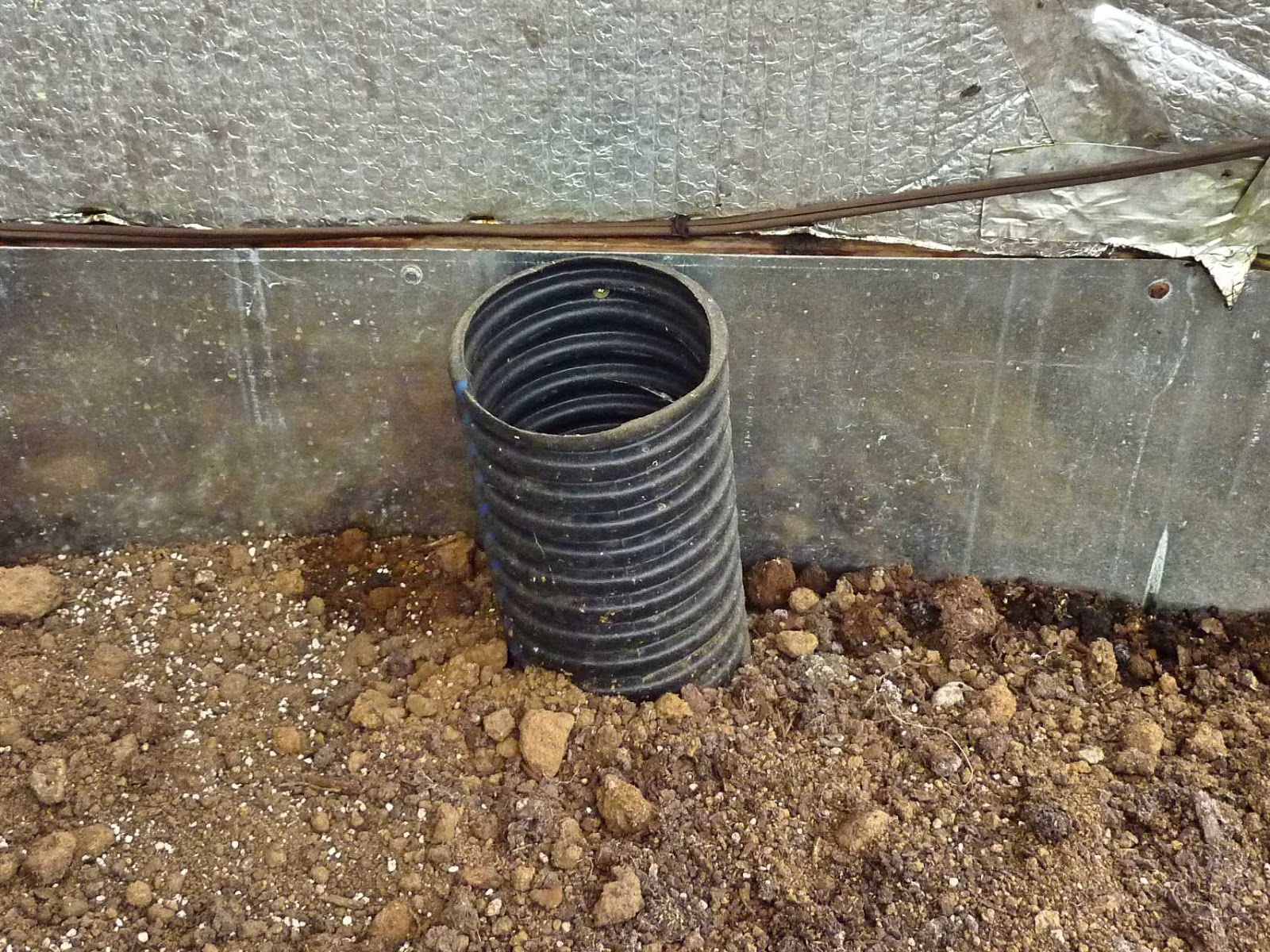
There are two four-inch diameter ribbed plastic pipes running the entire length of the perimeter beds at the interface between the native dirt and potting soil. The pipes lead from an air intake box near the center of the GH’s south side (the warmest place in the GH):

I replaced the seized-up original soil heater fan with a $10 computer cooling fan and hooked it up to the second 12” x 24” solar panel. When the sun is shining, the solar panel now powers the new fan, which sucks air into and pushes it through the two plastic pipes to heat the soils in the raised beds. Warm roots support veggies better than cold roots! This pic shows the exhaust end of one of the pipes emerging well above the raised bed to keep potting soil from falling into the pipe:


The water tank's bilge pump was seized up when I came on board, so it was discarded but not replaced. My friend said it never worked (!) and she didn’t miss it, so there are no plans to replace it. The electric wires from its solar panel are still in place but not connected to anything. I harbor thoughts of eventually installing a new bilge pump and using the water tank (pictured below) for more than just thermal storage, but that is a subject to write about on another day. In the spring of 2019, I plan to move the bilge pump’s solar panel to the southwest side of the roof and the soil heater solar panel to its southeast side. I will then wire the two solar panels in parallel to power the soil bed heating fan, which together should provide power for a longer diel period and heat the raised bed soils even better than originally designed.

The water supply for the greenhouse was originally a stop-and-waste valve spigot located outside the greenhouse about four feet away from the southwest ventilation panel. This had several undesirable results, including (1) having to run a hose from the spigot into the greenhouse through the SW ventilation panel, which was inconvenient and in the way of gardening operations, 
(2) the SW ventilation panel was never completely closed because the hose was kept there, causing warm greenhouse air to escape to the outdoor winter environment, and (3) the spigot was destroyed twice in freezing weather after being left on due to forgetfulness. I convinced her to let me and her handyman move the spigot to the inside of the greenhouse, which was done in December 2018, and I then attached a four-way brass water distributor (and a plastic wye) to it to provide five protected tap water sources inside the structure.


Next, I connected two soaker hoses to the distributor. For the short raised bed located along the greenhouse’s west side and beyond the door, I cut a short section from a garden hose, added male and female connectors to the severed hose ends, and ran the short hose to the short bed to connect into a 25 ft long soaker hose. This photo shows the hose running vertically along both lower sides of the door (the hose is also buried four inches under the floor sand).

The second soaker hose, 50 ft long, was attached to the water distributor and then run out and looped back to irrigate the long raised bed. Soaker hoses have small pores that deliberately leak water for irrigation, but some of the pores are large enough for water to squirt out several feet beyond the raised beds and be wasted. Therefore, I buried both soaker hoses 2-3 inches deep in the potting soil to capture all of the irrigation water. These two soakers irrigate nearly the entirety of the raised beds, excluding only the end of the long bed which is not yet completely filled with potting soil or contains any plants. That location will be topped up with potting soil and vegetated in the spring of 2019, at which time I will add another 25 ft long soaker hose to irrigate it.

The greenhouse has a lot of air leaks, allowing air to somewhat freely pass in and out of the structure. This undesirably cools the interior in winter, although probably also helps to beneficially reduce overheating in summer. Leaks are caused in several ways, and I have plugged some of them, but much more repair will be needed next year. As mentioned above, one leak was stopped by moving the water spigot inside the greenhouse, thus eliminating the need to run the irrigation hose through an always-open vent panel. A second leak was closed by replacing a rotted structural 2x4 that a vent panel was attached to. A third leak was fixed by reseating weather-stripping that had become loose and sagged away from a vent panel over time. A fourth leak was mostly closed by replacing two rotted structural 2x4 boards that were fitted horizontally to the outside Hardy-board wall. Finally, several vent panels did not close completely because the aluminum strips that cover and protect vent panel junctions were too long; these I cut shorter with tin snips.

The fourth leak mentioned above was difficult to repair, as the weight of the greenhouse’s transparent panels was upon the two rotted 2x4 boards. Furthermore, additional 2x4s atop the Hardy-boards are rotten and still need replacing, which will be a two-man operation that will be done during 2019. The greenhouse owner is somewhat sensitive to pressure-treated wood, so the original construction used untreated redwood or cedar 2x4s. While redwood, cedar, and some other woods are naturally rot-resistant, they certainly are not completely so, and we will be looking at alternatives come spring.

We have also had to learn a lesson in varmint control. The entire floor of the structure is underlain by eighth-inch wire mesh to prevent rodents from burrowing into the greenhouse. This includes under the raised beds, as mentioned above, and under the central floor’s four-inch-thick layer of coarse sand. However, today I spotted on the bottom of the water tank a drowned mouse that evidently fell in and could not climb out. We had been wondering what was eating the leaves of the parsley and red Russian kale, and were advised by neighbors that it was probably slugs, so we were planning to install beer traps. However, the mouse could also be the culprit, as a cursory search has yet to turn up a single slug and there are still many holes in the walls that need to be plugged. What do you think?

Lastly, the photo below of the center of the greenhouse should give you some idea of how much room there is inside. It is large enough to add a central raised bed, but we will probably not do so since she wants the space for meditation sessions. I hope to be able to show you more pics over time as we finish topping up and planting the existing raised beds, adding the additional soaker hose, adding hanging baskets, and allowing warmer weather over the upcoming spring and summer to create a lush indoor green space. I might even install some solenoid valves to completely automate the irrigation system.


Wednesday, May 9, 2018

Carolina Wrens in the House


A few days after I returned from Florida to my place in North Carolina at the beginning of March, a pair of Carolina Wrens (Thryothorus ludovicianus) built a nest on top of an electric outlet box in my house. The house was (is) still under construction, so they could easily get in and out at will. Over the next week, the female laid five eggs in the nest. I didn’t want to quit working on the house and didn’t want to evict the birds either, although I had already run off four or five flying squirrels (Glaucomys volans) from the eaves and a major nest of house mice (Mus musculus) from the basement. So, I just left the birds alone and went to work on the house.

The wrens and I puttered around each other, they warily and me deliberately. I tried to give them as much personal space as I could, but house construction went on regardless. Over the next two months they incubated the eggs and fed the hatchlings in the nest until yesterday, when the nestlings fledged. I don’t know how many of the original five survived, but I counted at least four. This photo shows three of them in the house:


The four young-uns and their parents freaked out when I arrived that morning, but three of the nestlings were able to fly from the nest area up to the soffit and then across and down into a mountain laurel bush (Kalmia latifolia) outside where they remained and rested for a while. The fourth nestling, apparently the runt of the litter, was too weak to make it up to the soffit. It tried to hide from me and then escape my gentle clutches, all to no avail:


I easily captured it and placed it outside in the shrubs where I had seen the others, but by then they were gone. Hopefully, its parents heard its weak chirps and came to rescue it, but it was no longer there when I checked on it later.

Of course, I immediately removed the nest from the house, and they have not since replaced it. If they try to do so, I’ll delete it before they can lay more eggs in it. However, my guess is that they have built a second nest elsewhere outside away from the Big Bad Buford.

I am amazed at how many species of wildlife have already tried to move in on me this year. Besides the flying squirrels, house mice and wrens, there are mud daubers, paper wasps, a scorpion, and numerous spiders. I am not alone.

Saturday, March 10, 2018

Flying Squirrels in My Corner


Every now and then a flying squirrel has been spotted in the house I’m constructing. Yesterday, I noticed that the volant rodent was using a spot on the outside of the house as a urinal. Pretty ugly. Today, I went on a squirrel nest hunt and found it in a boxed-in corner soffit just under the roof. I opened the wood face of the box and things got uglier. This pic shows the wood stained by urine, and to its left below you can glimpse the nest:


Peeking inside the box, you can see the nest a little clearer. It is composed of wheat straw I bought for the yard and shredded paper towels from inside my pickup. I am not just their landlord:


Looking a little closer, here’s one of the culprits:


All four corners of the roof have such “box.” The other three each had a single access hole, all of which I immediately covered with new wood plates. The corner nest box had three access holes, however, one being significantly larger than any of the other access holes and probably the reason they went for this particular abode rather than the others. I constructed three wood plates to cover the nest box’s access holes and sat back to wait for dusk. The idea is to fasten the wood plates in place so they can’t get back in after they leave their nest for their nightly foray. The squirrels cannot get into the other three corner boxes either, so they are forced to find a home away from my home. Hopefully, opening the face of the box and exposing the squirrels to predators will encourage them to skedaddle.

But wait! There’s a winter storm coming. Cold rain is expected and we could get sleet or even 1-3 inches of snow. Without an insulating nest to protect them from the coming chill, the squirrels could be killed if I evicted them just before the storm. They mate in Feb-Mar and give birth 40 days later, but this being a relatively cold location gives me hope that this animal will not drop her pups until April.

I guess waiting until several days of good weather are upon us would be the humane thing to do. That might give them time to construct a new nest elsewhere before I pull the old nest out and clean things up.

Sunday, February 25, 2018

Fish Dispersal to Isolated Waters


I have never liked the notion that fish eggs get dispersed via birds. The idea is that water birds somehow acquire fish eggs when they wade around in fish spawning areas and then transport the eggs to further water bodies. Sticky eggs allegedly adhere to bird feet and/or become trapped under feathers. It’s not hard to come up with other mechanisms, either, such as eggs being released from a dead fish when it is regurgitated by an egret feeding its young.

But none of those ideas wash with me. Sure, the eggs of some fish species are sticky, but lots of other species’ eggs are not and yet isolated water bodies can still have fish, even live-bearers. Indeed, the mosquitofish (Gambusia affinis), which is found in more aquatic habitats and more isolated surface water bodies than any other fish in the Coastal Plain, is a live bearer.

And the feathers of birds in the water are so tightly appressed that it is hard to see how eggs could get under them and hitchhike around. It is certainly reasonable to presume that some fish eggs get transported by birds, but it must be rare compared to the innumerable isolated water bodies out there harboring multiple fish species.

Then there’s the inconvenient fact that many small mountain streams and their little manmade reservoirs do not contain fish. This is because fish cannot pass tall waterfalls (and is the reason that salamanders are abundant and species-rich in the Appalachians). Furthermore, many reservoirs constructed here have existed for decades and are frequently visited by water birds, yet they do not have fish.

Thus, I welcomed the publication of research focusing on a review of the scientific literature that concluded there is no evidence for fish eggs migrating via birds (tinyurl.com/ya3m4whv). Fortunately, a lit review like this often sets the stage for experiments to prove or disprove a theory.  I can hardly wait!

The notion that fish themselves hitchhike rides on birds is even less likely than their eggs doing so. Water birds are largely fish-eaters and have excellent eyesight.

And then there’s the notion that fish can disperse via underground conduits. Sure, that can work with manmade culverts and to a lesser extent where streams running through vadose caves connect surface water bodies, but fish are much less likely to get around through phreatic cave passages. Nonetheless, the vast majority of isolated water bodies are underlain by dirt, which fish are totally unable to migrate through. Overall, the underground dispersal of fish must be trivial.

I believe that fish disperse almost exclusively by swimming. Many surface water bodies that today are isolated were connected in the past, which would explain how fish reached them. Less obviously, a connected wetland can fool the casual observer into wrongly thinking that it is isolated today; however, any competent civil engineer, geologist, or field biologist can spot tiny channels called “drains” that flow only during and immediately after storm events. Having been out in the woods in the rain numerous times, I can attest that many wetlands and ponds that look isolated are actually connected by tiny temporary surface streams during strong rain events during wet seasons.

I have personally seen several kinds of fish swimming upstream in such natural drains, including the mosquitofish and its taxonomic live-bearing cousins the least killifish (Heterandria formosa) and sailfin molly (Poecilia latipinna), plus bowfin (Amia calva) and various bream species (Lepomis spp.). I have also seen small fish swimming overland in the inundated ruts of a trail road that imitated forest “drains” during a downpour. Fish were coming from a river and going uphill to a series of small ponds.

Thus, I can think of numerous ways that fish can disperse by swimming, instances when apparently isolated water bodies are not actually isolated, and instances where fish do not exist in truly isolated places that are frequented by water birds. Case closed? Naw, now gotta prove it!


Tuesday, February 20, 2018

San Felasco Vine Cutting

There was a recent interview with Bob Simons in the Gainesville Sun (tinyurl.com/y856guk2) concerning an area in San Felasco Hammock Preserve State Park where someone had cut and killed woody vines (lianas). Bob said that the vine cut area was extensive and the cutting alarmingly thorough. The discovery caused quite a stir on a Facebook group that I belong to, so I phoned Bob to learn where the cut vines were located and last Friday went out there to see for myself.

I easily found the affected area that Bob pointed out thanks to his excellent directions and my own familiarity with the park. To map the impact area, I walked around its perimeter while recording the route on a GPS unit. Much of the cutting was obvious, with square-cut vines out in the open, whereas other cuts were hidden by a cover of detritus. After some exploratory prelims, I learned to (a) scan for large trees, (b) check their bases for accumulations of wrack (dead limbs and living and dead lianas), (c) walk over to each big tree wrack pile and look for cutting, and (d) look for cut vines along the way. Veiled cuts were unmasked by pulling on intact-looking vines to see if they were loose (some of the veiled cuts produced adventitious roots that made it to the ground and rejuvenated the vine).


Afterward, the route and waypoints were imported into Google Earth (GE) and I did the best I could photointerpreting the area’s habitats from GE imagery, county topos, and my GPS route and notes. It is very difficult to map San Felasco’s upland plant communities based on aerial imagery, but I think the approximate impact acreage I got is close enough for current purposes. However, I only looked at the one area that Bob directed me to, and there are many such impacted locations at San Felasco. The red polygon is the area impacted and the white polygons are appx wetland edges:


The cutting was done along the side slopes of the multiple-sinkhole blind karst valley in the mid-south region of the park on the north side of Millhopper Road. I estimate this single affected area at appx 22 ± 5 acres. The impacted slopes are dominated by a mature mesic oak-hickory-magnolia-sweetgum forest, whereas the karst bottoms are wetland and aquatic habitats that are essentially absent of lianas. The highlands immediately surrounding the impact area are also occupied by mesic forest, much of which is mature, but there is an earlier sere to the southeast. Only rarely did vines appear to be cut in the highlands and only occasional vine cutting was spotted beyond the core area.

Within the core area, nearly all the lianas that had made it up into the canopy were cut. It looked like the cutter wanted to kill nearly all of the large wild grapes (Vitis aestivalis, vulpina, and rotundifolia), about half of the large trumpet creepers (Campsis radicans), and none of the large poison ivy (Toxicodendron radicans) and peppervines (Ampelopsis arborea). All four of the encircled stems in this photo were grapevines:


There were not as many vines in San Felasco’s undisturbed mature mesic forest as I had imagined, there being so few that it would be easy to count every single liana stem that made it up into the canopy. I counted in the impact area only five trumpet creeper vines and two individuals each of poison ivy and peppervine, although I could have missed some, and I counted only the large vines that ran up trees. Some of the areas peripheral to the impact area appeared to have no lianas or cut wrack whatsoever, either in wetlands or highlands. Were they naturally without vines or had their lianas been cut long ago and by now completely rotted away?

Cut vines were in variable states of decomposition, with some stumps looking like they were cut a year ago and others up to several, so the cutting appeared to have been done over a multi-year period. It is possible that the low density of lianas in adjacent highlands is an artifact of having been cut away so long ago that their remains have completely rotted away. If so, then the impact area could be significantly larger than my acreage estimate.

I wonder if the cutter has (had) a plan. First, deliberately leaving some individuals of all species indicates that the cutter was not trying to (a) eliminate lianas altogether or (b) extirpate any species. Rare canopy achievers (poison ivy and peppervine) were not cut at all, the more common trumpet creeper was occasionally cut, and grapevines were abundant and slaughtered. That is exactly what one might do if one wanted to reduce the impacts of lianas and increase their species diversity without decreasing their species richness. Secondly, liana thickets were left untouched, which could be due to either wanting to preserve a specialized wildlife habitat or just not wanting to tackle such a big job.

Third, possibly the healthiest large trumpet creeper I have ever seen was within the core area but not harmed. This one vine also provides a protective doorway at the fork of its two main roots for a small animal burrow. A man with a plan might deliberately spare such resources:


I wish now that I had paid more attention to the tree species that the trumpet creeper grew on to see if the cutter selected for or against vines based on the quality of the tree infested. For example, although the massive vine pictured above is clearly stressing a sweetgum, it does not cross over and encumber any other trees and I think many Florida naturalists would agree that this particular vine is more valuable than that specific sweetgum.

Clearly, more field work is required! In addition to looking further at the trumpet creepers, mature mesic hammock elsewhere in San Felasco needs to be scrutinized to see if the cutter has more than one haunt. I can justify one more day at San Felasco before migrating back to the mountains for the muggy hot months.

Tuesday, October 24, 2017

Evolution of Wolf and Dog Behavior

Image by Greg Koch, USFWS

Wolves are said to hunt in cooperative packs, but that generalization is not necessarily so. First, Farley Mowat (Never Cry Wolf, 1963) taught us that wolves in the Far North of Canada and Alaska hunt singly when raising pups. Secondly, the coyote hunts singly when raising pups and sometimes doubly as a mated pair, but also as a family pack when pups are large enough to join their parents to learn how to hunt. The latter assumes (as I do) that we accept the coyote as a subspecies of the timber wolf because their hybrids are fertile.

Similarly, domesticated dogs are often said to hunt singly, but that is also an over-generalization. Stray dogs are known to band up and hunt in packs, attacking people and other animals. Furthermore, feral and stray female dogs take their young on hunts.

It is commonly written that dogs evolved from wolves that hung out at the edges of human camp-firelight. The idea is that the friendliest and most cooperative wolves were favored by early hunter-gatherer humans, creating a positive feedback mechanism that augmented natural lupine sociability.

However, suppose that early wolves were more like their Far North siblings and lived in mated pairs. Then suppose that the early wolves that found human subsidies irresistible were forced to become more sociable in order to survive at the campfire perimeter. This is not an unreasonable scenario for at least two reasons:

First, dogs have been called neotenic (immature) wolves due to the dog’s physical and behavioral characteristics being very similar to those of the young wolf.

Secondly, the fossil record does not obviously record ancient dog and wolf behavior, so we do not know what either actually did. It is often said that bones fossilize but behavior does not. However, at least some of the consequences of behavior actually can be evident in fossilized bones. For example, a research project (tinyurl.com/lgpw6du) evaluated injuries to the preserved bones of California dire wolves and saber-toothed cats and found that wolves were more prone to head and neck injuries whereas saber-tooths were more prone to spine and shoulder injuries. The researchers then concluded that this was because dire wolves hunted in packs and attacked large hooved ungulates from behind and thus were occasionally kicked in the head and dragged by their prey like modern wolves. Saber-tooths, on the other hand, ambushed and then manipulated prey with their powerful back and forelimbs into such positions that their long teeth could deliver precisely aimed wounds to carotid and jugular blood vessels. Another finding was that saber-tooths sustained more injuries, leading to the opinion that they attacked larger prey and did so alone.

Thus, some behavioral patterns can indeed be teased from old bones. Similarly, research shows that food items can be deduced from tooth wear patterns, food sources can be determined from element isotope ratios, migratory patterns can be concluded from isotopes and wear patterns, and care for the injured and aged can be demonstrated in nursed skeletons. It is only a matter of time before there are enough skeletons and sufficient interest and funding to shed light on ancient wolf and dog behavior.

Today, I read of an interesting paper (tinyurl.com/ybwf4pyn) in BBC News (tinyurl.com/y9lssctg) that expanded on canine cooperativeness, which demonstrated that living wolves will cooperate with each other more than dogs will. I was not really surprised at this finding. I have read numerous technical reports on wolf-dog behavior in preparation for the second book I started writing, so I already believed that young wolves and adult dogs were less sophisticated socially than adult wolves. However, in reading this research, I have for the first time been struck by a more radical set of questions.

Instead of dogs alone evolving toward a human-associated existence and away from a lupine culture, is it possible that ALL wild wolves living in close proximity to humans have evolved more sociability and that the dog and wolf are both evolving alongside and toward human acculturation? Are wolves more social now than before humans evolved? Are wolves more social now than before dogs evolved? Is the Far North wolf culture the primitive state and the wolf pack culture a derived state? Did the wolf pack culture evolve as a consequence of single and doublet wolves gathering around human campfires where they had no choice but to become more social? We know that humans created the modern dog, but did we also create the modern wolf?


Monday, June 12, 2017

Stone Mtn Dupont State Forest Trek

In my peregrinations to find interesting geologic features of the state’s granitic gneiss high elevations, Sunday I set off for the north side of Stone Mountain where Google Earth depicts a line of steep exfoliation cliffs, rugged terrain below the cliffs, and a mature hardwood forest. Unfortunately, the park has no official trails leading to the cliffs, but I hoped that rock climbers had some guerrilla trails I might stumble on and follow. Nope. Ain’t. The best I could do is hike up Rocky Ridge Trail (#75) from Old CCC Road and then strike out off-trail. It was an easy start, only about a 30 degree slope, and I headed a little east of north up to a saddle. From there, I wanted to angle off more to the east, but thick rhododendron contraindicated that so I continued on the previous direction to skirt it and followed the contour. Still pretty easy.

The rhododendrons soon forced me to alter direction toward the southeast and uphill, although still only a 30 degree slope. I was at an elevation of 2900 ft at that point, which was about what I thought would be the base of the cliff line. I tried to follow that contour but the rhodos kept pushing me slightly uphill for a quarter-mile until I encountered a low, wide rock shelter along the 3000 ft contour. This feature was at the base of a talus field that was about 100 ft in elevation below the cliff-base line. I stopped there for a moment and discovered that, alas, I had forgotten my flashlight, so I bellied down and waited until my eyes were accustomed to the dark to see what I could see. Not much. The shelter just got lower and lower from its entrance, which itself was only about 2 ft high.

I continued to hike slightly uphill on the by now 45 degree slope. Talus fields are hard to negotiate. The ground around these boulders ranges from a relatively easy 45 degrees to almost vertical, the talus fields support dense rhodos with intertwining branches, dead twigs want to jab your eyes, rhodo leaves are large and block your vision of the ground you walk on, the terrain is dark and snaky, holes between the boulders are covered with leaf packs that do not always hold your weight, and greenbriar vines are common to abundant.

Time out. My Florida friends do not understand mountain greenbriar (Smilax sp.). Florida has much, much more greenbriar than these mountains harbor, but… Florida greenbriar will prick you and draw a drop of blood or two, but if you are careful, you can walk through infested landscapes receiving only a few minor scratches from their flexible little (eighth- to quarter-inch) spines. Mountain greenbriar, however, has up to half-inch long inflexible rakers that are flattened laterally, the tips of which are way sharper than Florida greenbriar and their edges are razor sharp. All you have to do is barely touch a mountain greenbriar and you have a cut that will bleed profusely for several minutes.

Whatever, I scrambled up another 100 ft in elevation and tenth-mile through that crap to the base of the first cliff and immediately spotted an Eastern box turtle (Terrapene carolina carolina). As the photo vaguely shows, there were some dings on the chelonian’s carapace that looked like teeth marks from a mammal larger than a canid or bobcat. I’m guessing the turtle was attacked by a bear, but don’t really know. It seemed to have healed from the one-sided battle. I ate lunch (not the turtle) and moved on.


Continuing more-or-less along the 3000 ft contour, I inspected several more exfoliation cliffs, always seeking the path of least resistance through the rhodo thickets. At that point I was pretty tired, but determined not to return the way I came. You cannot go back the way you came, it’s a Rule, so when I came to a non-rhodo-covered 45 degree slope I began angling uphill toward a low lateral ridge that I hoped would take me to the Stone Mountain ridgeline where an official trail would take me to my ride. It almost did, but things changed after another tenth-mile to a horrid 60-70 degree slope covered with boulders, rhododendron, mountain laurel, wild azalea that didn’t have the courtesy to be blooming, highbush blueberries that didn’t have the manners to offer fruit, and greenbriar that was even more abundant than before. Sigh. Furthermore, galax grew lushly and obscured the ground, and I just knew that I was passing close by invisible timber rattlers and copperheads. Man! In places like that, you’d better not reflexively stick your hand out to the ground to steady yourself when you stumble. Grab the rhodo stems instead! I spent an hour-and-a-quarter thrashing my way through 0.8 miles in that horrible place. I could only think of my goal. Ridgelines are supposed to be drier and support shorter trees and a more open understory, and that was supposed to be my salvation. Nope. Wasn’t.

Just when I thought it couldn’t get any worse… I couldn’t yet make it to the ridgeline, specifically up a knob along the ridgeline, because that awful knob was worse than anything I had gone through so far. Steeper terrain, denser rhodos, more greenbriar, downed logs and limbs, and everything covered with slimy lichens and slippery sphagnum moss. I had no choice but to continue through the lesser of the two evil rhodo thickets. I was out of water. I thought I was gonna die there and be found only by hungry scavengers, my wasted bones scattered amongst the rocks and rhodos, and eventually overgrown by sphagnum.

But no! After only another fifteen minutes and a tenth of a mile, I broke out of the thickets growing on and surrounding Hateful Knob and onto the ridgeline and AN OPEN UNDERSTORY!!! Hallelujah! And to make matters even better, there was a vague trail leading along the ridgeline exactly in the direction of my parked pickup. I followed the trail west for another half-mile and 20 minutes to the official mountaintop, gaining another 600 ft of elevation. There, I was rewarded by scenic views that I could not have cared less about and lowbush blueberries sporting a few ripe fruit, which I gobbled down to quench my thirst. Wild blueberries are sweeter than ag blueberries despite being smaller. Heh, most of the people I run into on the mountaintops are afraid to eat them, and I shamelessly pander to their fear (“No! Wait! Don’t eat that wild fruit! Let me save you!”)


After that, I grudgingly took the well-beaten trails back down the hill, but only because you can’t go back the way you came. Seriously! Total time was 5:25 and total mileage was 5.9. It was not a death march like some of my off-trail hikes, but it was hard, maybe the hardest trek I have done since moving here. The friend who accompanied me last weekend wearing a 40 lb pack will doubtlessly be glad that she was not with me today and wearing another heavy load.

So Tom, bring Jimmy and the gang up from Florida sometime and we’ll go out and play!


Note: I would have added a Google Earth pic of the route I took, except that for some unknown reason my Garmin software won’t hand off the track to GE. It used to do so easily, so I’m going to call Garmin soon and see if this can be remedied. If so, I’ll update this missive.