Dicromantispa interrupta

Dicromantispa interrupta
Mantisfly

Monday, September 27, 2010

Butterfly Rattlesnakes!

Bruce and I have been exploring the bike trails and karst terrain of a property on the west side of Gainesville over the past two weekends, covering 7.7 miles on the 19th and another 4.9 miles yesterday Sunday. Most of that mileage was single-track biking, but yesterday’s route also included a mile or so of pushing our bikes through briary brush. We found five active sinkholes and a pretty cavern, but unfortunately no caves.

Bruce named this cavern Sombrero in honor of his straw hat:


Leading along a bike trail yesterday, Bruce spotted an eastern diamondback rattlesnake (Crotalus adamanteus) crossing the path and slammed on the brakes before hitting it, slowly slid off his bike and reached for his camera. After pulling it from the pouch, he took several steps forward to snap some photos of it while I stepped forward onto the spot where he had just been standing. Something on the ground about a foot away from my left leg caught my eye:

Gulp! This species has been called the most dangerous snake on earth due to its having very long fangs, large poison sacs, toxic venom, overall large size and great abundance in frequent proximity to humans. Yes, we are thankful that the eastern diamondback rattlesnake is not quick to bite! Here’s a shot of the first rattler:

The one at our feet was a lady and the coiled serpent was a gentleman, both of them being about 4 – 4.5 ft in length. Neither of them ever lunged or made any attempt to bite us. The female never made a sound, although the male shook his rattles continuously during our presence (note the blurred tail tip).

I really don’t know why the species is called the “diamondback.” You can clearly see that their back pattern more closely approximates a bat or butterfly shape, not at all diamond-shaped. I’d suggest the alternate name of bat rattlers, although they might be more marketable to the warm and fuzzy crowd by calling ‘em butterfly rattlers.

They weren’t the only snakes we saw yesterday. Sadly, after parking my truck in his yard after the biking, we found this colorful little red-bellied snake (Storeria occipitomaculata obscura) dying in the tire tread print. This species (subspecies) is pretty common, but hides and forages under rocks, logs and leaf litter and thus is seldom seen. Some of their behavioral quirks are fascinating:

“The red-bellied snake exhibits a curious behavior known as "lip-curling." While both ingesting prey and being threatened, they flick their tongue and curl their lips upward to show their small maxillary teeth. This is thought to have some benefit for prey seizure, but it may be just as important as a deterrent to predators. When handled roughly they will sometimes exhibit the lip-curling, then rub their head sideways on the captor scratching their teeth against the flesh. The teeth are too small for this to be harmful to humans and is barely even noticeable. As with many other snakes when captured, they often release musk and smear the captor with cloacal matter (Amaral 1999). Occasionally they may even play dead by going completely limp until they think the coast is clear (Watermolen 1991). A much more dramatic display of death-feigning has been recorded. The particular snake wiggled its tail, twitched the back of its body, rolled over exposing the red belly, held its mouth open, protruded its tongue, contorted its body, and then went completely stiff instead of the usual limp display (Jordan 1970). It is not known if this is actually a death-feigning display or a stress induced seizure (Harding 1997).” From http://tinyurl.com/33r9bhr

Saturday, September 18, 2010

Mary Susan Nicks, 1929 - 2010

On my way back from NC today, I attended a funeral in Fernandina Beach, FL for Mary Susan Nicks. She was first my babysitter and later, when my mom married the father (Joseph Pocher) of her children, she became my stepmother. She was a good and kind person, had a positive influence on me and I mourn her passing. She raised four fine children to adulthood, and they are a testament to her character. May she rest in peace.
http://www.legacy.com/obituaries/timesunion/obituary.aspx?n=mary-susan-nicks&pid=145429320

This is a photo of her three surviving children, Joseph, Ann and John:

Sunday, September 12, 2010

Mountain Lot Creek Work

This post is not about Florida nature, but that’s ok, right? I am in NC working on my house lot in the beautiful, cool-weather mountains of western North Carolina. My goal on this trip is to install a septic line from the septic tank to the inlet for the RV and electric lines from the road to the RV pad. The county requires the septic line to be emplaced by a licensed plumber. The only plumber I have talked to so far wants $1500 to lay a 70ft long line and I think that’s too much. I plan to get a couple more bids, but if that’s what it costs then I just may take the allegedly “easy” open-book exam and become a licensed plumber myself! That’ll go well with my hazwoper training, inactive real estate license and gopher tortoise agent certification. Think that’ll get me a cuppa coffee?

My goal today, Sunday the 12th, was simple, to stick a couple dozen wildflower transplants in the ground on the lot, and I did that but first had to deal with an erosion problem. It rained cats and dogs yesterday, and my driveway funneled surface water into some right places and some wrong places. The dirt at both ends of the culvert where the driveway crosses a first order stream got eroded away somewhat, not enough to panic but sufficient to require mitigation. I therefore felt it wise to spend about 5 hours this morning and early afternoon hauling rocks and green logs and shoveling water-saturated dirt around. All those things were heavy. My back hurts and my left arm is cramping even now, almost 6 hrs later, but here is the result:

If you know anything about stream dynamics or erosion, you know that bulkheads seldom last for long, plus, ecologically, bulkheads are BAD because of the limited amount of wildlife habitat associated with them. But if you know anything about the biology of temperate montane rain forests, you know that mosses, ferns, wildflowers and roots will soon enough tie it all together in beautiful harmony, and there will be plenty of wildlife there.

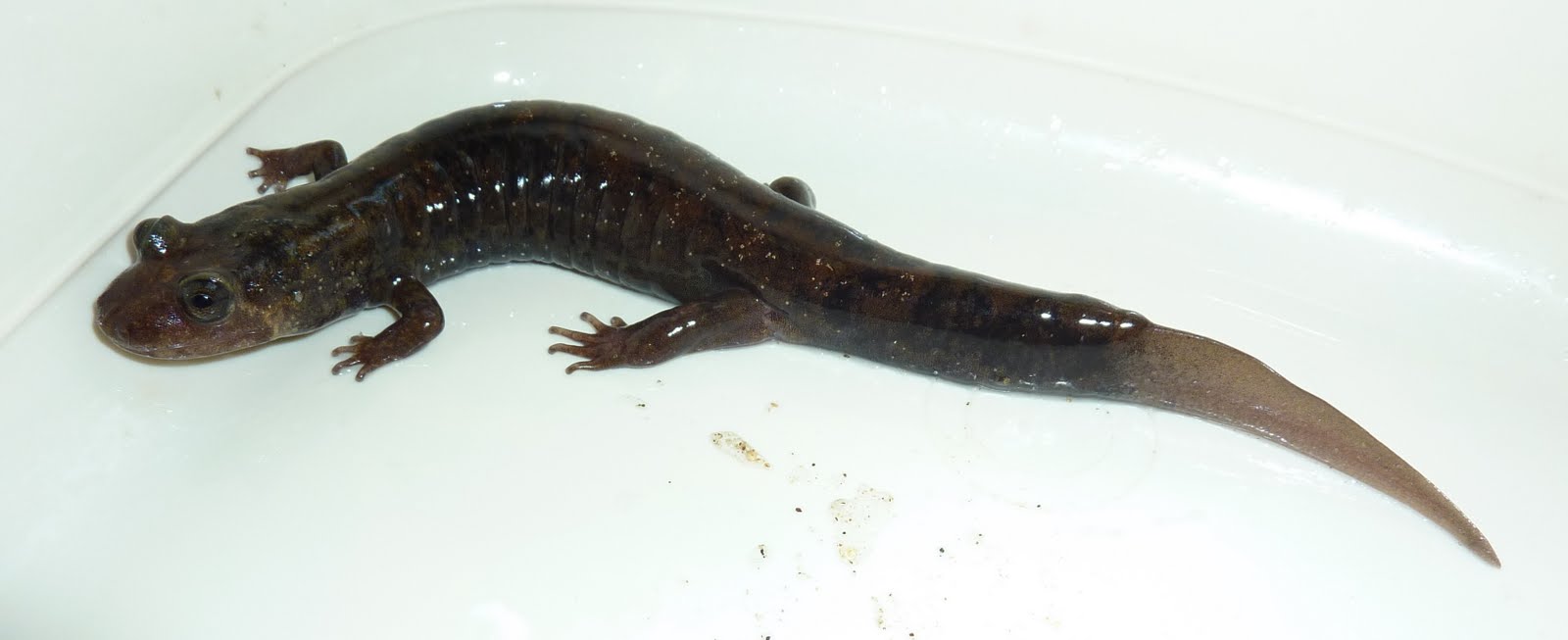
I have spent numerous weeks lately working on the lot, clearing trees and shrubs, rolling up root mats, wandering around and turning logs and rocks and so forth, but in all that time I have seen only one small salamander and one ground skink. I have been wondering, “Where are the herps?” Well, working in the creek today I found out: they are all in the creek and under the root mat that was hanging out over the creek. I caught a spiffy ringneck snake today with a back as sheeny black as you could ask for, and with a bright yellow neck ring, but was myself caught up in shoveling, filthy and sweaty, and didn’t want to pollute my camera so let it go without photographing it. Afterwards I kinda regretted that, so when I caught a big salamander I collected it in a ziplock bag and brought it back to my home away from home (Uncle Dave’s place), photographed it, and tried to key it out. I think it is a Northern Dusky Salamander, Desmognathus fuscus. It is robust beast, maybe 5 inches snout to vent, and about 0.75-inch wide. I can’t tell if the tail is re-grown after being bitten off by a predator or if that translucent tail is just what they look like (that is not a water line on the tail; there is no standing water in the container other than a few drops). Later, I returned to where it was caught and released it.

I saw a couple more, smaller salamanders in the creek but didn’t try to catch them or photograph them.

Notice in the photo of my handiwork above that I have placed rocks in the stream bottom. What you can’t see is that I first placed a layer of irregular-shaped rocks on the surface of the gravelly sand bottom and then placed a second layer of flat rocks on top of the first. Hopefully, salamanders will be able to roam around between the two rock layers protected from most predators, making this excellent salamander habitat. My philosophy here is that if I am going to create a biologically bad bulkhead, then I have a responsibility to make what’s left into good habitat. I think that’s fair.

I hope to find a roadside ditch where I can collect some wetland plants to place around the bulkhead and side slopes, to give a head start to revegetating the scene. This will be harder than some of my Florida friends realize, however, because up here in the mountains there are no real road shoulders to pull over and park on. There’s just the asphalt, about 18 inches of grassy dirt and then a ditch. I’ll search around and find something though, it’ll just take some patience.

I’ll repair the other side of the culvert when my back and left arm recuperate. Groooan!

Sunday, September 5, 2010

San Felasco State Park - Labor Day Weekend 2010

I took a rather easy trip today to my favorite Florida state park, San Felasco, biking about 4.9 miles and hiking 2.6 miles. I would have hiked further but high waters in Sanchez Prairie kept me from my mission. I am in search of an elusive karst feature, a tall-grass pond that a stream flows into and then disappears into the ground below some large flat boulders that may actually be limestone bedrock pavement. I stumbled onto the feature twice, years ago. Both times I didn’t spend enough time deciphering its geology nor did I take photos of it. I have searched for it in Bruce’s company several times, once with Brack and a couple of times by myself including today, all to no avail. Annoyed!

This is a good mystery, however, and is guaranteed to keep seducing me back until I find it, even if it takes me umpteen trips to do so. It’s a good place to be, perhaps not as lucrative and dangerous a raid as an African tomb, but hey, I’m only a weekend warrior. Right? And there are other kinds of treasures along the way…

I rode my spanking new mountain bike eastward from the parking area to the power line R/W and then south along it to the gate beyond which bicycles and horses are forbidden, and stashed the bike in the oak-hickory-pine woods. This forest will ultimately staff up with many more hardwood species like Southern magnolia, basswood and winged elm, but alas, I must be resigned to American ash and redbay probably not ever making it due to the emerald ash borer and whatever fungus it is that’s killing off our Persea bays (redbay, swamp bay and scrub bay). Oh well, at least sweetgum is not especially common, and the trees here are nice and mature. Glass half full.

After stashing the bike, I walked over to the open water’s edge under the power lines where they crossed Sanchez Prairie to see for what wildlife might be visible. A rather loud barred owl was shouting “Wa wa wa Wacahoota!” Clearly, it was a plaintive cry to bring back that nearly forgotten whistle-stop along a defunct railroad that ran south of Micanopy, clearly to me, anyway. But there was another sound, a soft splashing in the shallow water only 100 ft away in the swamp. I thought it might be feral pigs rooting around the edge of the water, but it sounded too soft for swine, plus there was no grunting. I slipped quietly towards the commotion, crouching low as I went until passing beyond the forest edge off the R/W, and then I saw it! It was a river otter, cruising at an angle away from me, alternately under water and then breaching the surface for air and observation. I don’t think it saw me, but maybe. I was too far away to get a good picture of it, but this will at least give you an idea of its foraging habitat:

I waited until it was out of sight and headed back to the east to continue my mission. As soon as I entered the forest on the other side of the R/W five wood ducks flushed from the water, whistle-whining as they went in complaint of my presence. Last winter this area harbored perhaps a hundred woodies, and I suspect that many again will return this year. Only a few hundred yards further on, a handful of white ibis foraged unconcernedly in the prairie’s mud without taking flight at my intrusion. A great blue heron squawked a little further away. This photo will give you an idea of the park-like atmosphere landward of the swamp:

There is a lot of water in the prairie this year, much more than last year when I could walk across the R/W without getting my feet wet. There are too many large alligators in this prairie for me to chance a foot crossing at this time, though. Although the water is currently a little high, take a gander at the high water lines on these trees 4+ ft above the low hammock’s ground surface:

The north edge of the prairie has hundreds of 4 ft long white PVC pipes outlining what I think is a previous water’s edge a few inches higher than today’s. The pipes are appx 10 – 30 ft apart, and they sure do take away from the otherwise natural feel of the site. After the holiday weekend, I must remember to call DEP and ask why they are there. They are not at a jurisdictional wetland edge for sure, as I used to delineate wetlands and these are all well waterward of the legal lines:

I only saw two deer. Wow. Usually many more are in evidence. A blue jay called in the distance, giving me the opportunity to practice my blue jay calls. I bet you didn’t know that I can almost imitate a blue jay, did you? Heh, but after 40 years of trying, I still can’t get it right. Blue jay calls are hard, so hard that I can’t remember how to do them unless prompted by a real jay, so don’t ask me to try it at your next party.

How about this spiral mushroom:

What may be Florida’s commonest milkweed, Asclepias perennis, always found on floodplains:

A woodpecker’s grocery store:

The river otter was a cool sight, especially coming at the beginning of the hike (harbingers!), but the last denizen of the forest I was lucky enough to spot was a water moccasin that was every bit as cool. Perhaps 2 ft long, it was coiled at the base of a tree among a set of fallen, small dead pines strewn about like pickup sticks. The serpent had the clouded eyes of one soon to shed its skin. It remained completely still throughout my photography gymnastics, never even testing the air with its tongue. Now that’s a calm snake! Or a sleeping snake? Even after I left and continued onward, when I passed back by 15 or 20 minutes later it was still there, still unmoving, still tight-lipped, an example for us all:

Saturday, September 4, 2010

Tracks Identity Revealed

I have replaced the white water lily photo in the header with a pic I took of a favorite lizard species, the Florida scrub lizard (Sceloporus woodi). It is endemic to Peninsular Florida and found only in xeric, high pine scrub habitats. Its populations are highly disjunct due to strong habitat exclusivity, as high pine scrub also occurs in highly scattered, isolated locations. Possibly, this serpent evolved during Plio-Pleistocene times when sea levels were higher and the peninsula was reduced to a few islands. I never once saw it in the citrus groves on the Lake Wales Ridge when I used coverboard traps to assess herps along the pipeline route last summer, although nearly every other (if not all other) lizard species occurring on the Ridge was present.

Ok, I have an id on last weekend’s mammal tracks. I corresponded with a professional animal tracker, Kim A. Cabrera (http://www.bear-tracker.com/), who assured me that they are from the common raccoon, Procyon lotor. I was fooled by the way thin toe prints can become widened in soft sand. Here’s a synopsis of how different they are compared to ‘coon tracks in mud or clay:

1. The prints are up to 3 inches long and 3 inches wide. Although raccoon tracks can be that long, they are typically appx 1.5 inches in width; however, I suppose the wet sand sediment might not have provided firm enough support to the weight of the animal, resulting in the toes splaying apart.

2. The toe pads are as wide as they are long whereas raccoon tracks are longer than wide. This could be the result of the sand being "splashed" outward as the animal bounded along two paws together at a time (prints were always nearly equally side-by-side in the sand). After revisiting the pic, I can see where there is an "axis" to the toe prints, indicating the toes are not rounded but are more elongate.

3. There are no claw marks above any of the tracks, whereas raccoon tracks generally display light claw marks when walking slowly. I do note, however, that Cabrera’s website shows some raccoon tracks clearly without claw marks. In the photo on my blog, I can barely see possible claw marks on the left print but no claw marks on the right.

Ok, ok, I’ll admit I’m sometimes too left-brained!

Monday, August 30, 2010

47 Runs and Atsena Otie Key

Sunday was a two-adventure day, first to the braided Wekiva River Swamp south and east of CR 326 just north of US 19/98 and second to Atsena Otie Key off Cedar Key.

The purpose of the first trip was to document the wetland status of a 20-acre parcel called "47 Runs" that the Suwannee River Water Management District had misclassified as uplands and listed for sale as surplus lands. Many broad-brush maps such as my Garmin GPS maps and the USGS Quadrangle had mislabeled the parcel as uplands also, and District staff had never visited the site, so it is understandable that they might have initially gotten it wrong, but if they had taken a brief look at the property in person I believe they would not have made that mistake.

My circle of local naturalists knew from a recent visit that the parcel was a mix of mesic hammock, low hammock and bottomland hardwoods, and that the latter habitat was directly connected by surface waters to the Wekiva River swamp’s northernmost braid, so Brack and I spent a couple of hours on site collecting plant species lists and photos showing the wetland nature of the parcel. I then spent a half-day earlier this morning writing an ecological assessment of the parcel and associating the photographs with lat/long waypoints. Hopefully, Brack will be able to use our findings to convince District staff to reverse their previous stance and remove the parcel from the list of surplus properties.

In case you need any convincing, here are three photos of the low hammock and bottomland hardwood habitats:


The trip to Atsena Otie Key in the Cedar Keys National Wildlife Refuge was made in Brack’s sea kayaks. He had rounded up a couple of paying customers through the Santa Fe College adult education program, billing it as an adventure in the prehistory and history of that island, and his grasp and explanations of same are enlightening even to an old time Floridian like me. The wind was rather stiff out of the east, but our low aspect on the water in the kayaks reduced its effects to a minimal degree, so the paddling over from Cedar Key and back was easy exercise. I joked that if we had been in canoes, we might have been blown out to a Pleistocene shoreline; it would have been a strenuous stretch of stroking.

An excellent brief history of the island is provided at http://www.fws.gov/cedarkeys/atsenaotie.html. In a nutshell, it was used by prehistoric Native Americans dating back appx 5000 years, was the site of a mill that produced cedar wood blanks for making pencils, a resort for Florida and Georgia planters and an important shipping port and is now a wildlife refuge managed by the US Fish and Wildlife Service. John Muir visited the place when he walked from Indiana to Cedar key, and even got a job in the Faber pencil mill for a short time and almost died of malaria there.

There is a dock and short trail on the western side of the island, the trail leading to three interpretive boards and the dock used by locals for fishing. Not far to the north from the dock is a small pet cemetery, where this marker to someone’s beloved dog can be found:

The cross on the marker indicates that the dog was a Christian. Imagine that! LOL

Brack is not only a paddling guide, but also an archaeologist by education and showed us a whelk shell that had been used by Native Americans as a tool. Notice two things: (1) the hole in the side of the shell where a stick had been driven through and tied on for a handle and (2) the very eroded, smoothly rounded pointy end of the shell indicating that it had been used (for digging, etc) long and hard enough to have been worn back 1 – 2 inches:

Here’s a close-up of the pointy end, showing its cultural erosion a little better:

The east side of the island has an old cemetery that has been vandalized, as so many other old cemeteries in Florida (and the world) have been, but their information and ambiance remain for our gratification:

Just before leaving the island, while crossing a soft sand bar we encountered various tracks including these strange ones. The individual prints occurred in side-by-side pairs and were left by two individuals traveling side-by-side, one set of tracks being almost 3 inches long and the other 2.5 inches long. Notice that there are five toe marks above the “heel” pad, no claw marks whatsoever and that some of the tracks had toe-drag marks in the leading direction. We have no idea what animal left them. Brack and I both have track mark books, and the only mammals around here that leave five toe prints on the ground are the opossum and river otter; however, the tracks are too regular to be those of an opossum and do not have any of the features of an otter. In the field, we thought at first they might be from a felid, but cats leave only four toe marks on the ground; likewise, only four toes are imprinted by canids (plus canids leave claw marks). Does anyone out there in the blogosphere have a clue as to what might have left these prints? Could it have been cucachabras? Inquiring minds want to know!

Sunday, August 22, 2010

A night in the life of a redneck

Stop me if I’ve told you this story. But first, I gotta tell you that I was reminded of it by a wonderful blog I just discovered written by Lynda, called Mainly Mongoose. Absolutely, you must check out her posts (http://mainlymongoose.blogspot.com/), especially the last two or three about lions and elephants, which precipitated this posting.

I was 15 years old and living in a trailer on the Westside of Jacksonville, Florida on the very outskirts of town near Cecil Field, a Navy base. By outskirts, I mean that beyond our little trailer and clapboard neighborhood there was nothing but pine flatwoods, cypress and gum swamps and blackwater creeks. It was a fine place for young male hellions such as my friend Danny and I, ‘cuz there were plenty of snakes and bream to catch and bobcats to watch zinging across dirt roads at night in front of headlights. I don’t believe that I have ever before or since lived in a more wildlife-abundant place.

One of the neighborhood fathers had constructed a treehouse in the flatwoods not too far from where we all ordinarily slept, and it was palatial as far as most treehouses go. No, it wasn’t a Disneyesque Swiss Family Robinson McMansion, but it beat the pulp out of any other treehouse I ever got to play in. The man had found four stout pines growing in almost a perfect square, and had built a 6-sided wooden box about 8 ft off the ground among them. It had 4 walls, a door and 3 windows in addition to the requisite floor and roof. The walls were lapboard and the plank roof was covered with roll roofing (rock-covered asphalt felt). The door could be latched from inside as could the storm-shuttered windows. He was a good father.

The event happened on the first night we camped out in it, natch! Some of the kids didn’t have sleeping bags and it was cold, so they brought carpets to roll up in. I am not joking about the carpets – this was not an affluent neighborhood. We had a little campfire downstairs and cooked up some marshmallows and hot dogs before turning in. Boy, were we cool! No parents were present to lord it over us and we were sooooo confident in our independence. Of course, all the neighborhood dogs were present too. Hey, they were not about to miss a campout with kids and weenies!

As the evening wore on, we got sleepy and decided it was time to lay our heads down, so up the ladder we went and settled in for a good night’s sleep. The dogs were made to stay below to “guard” us, a job they took seriously, I’m sure. We battened down the hatches by closing and latching the door and shutters, said our prayers, chattered for a few more minutes, and then as the little ones drifted off, we elders shut up and lay awake listening to night sounds. There were katydids, tree crickets, nighthawks and chuck-will’s-widows sounding off for the evening, and all was really quite peaceful and well with the world.

Suddenly, the dogs started barking. At first, they only barked curiously, alertly, but after a short time began barking in a more worried timbre. This soon segued into a fearful, whiny barking that subsequently evolved into out-and-out yelping, and the next thing we knew the dogs were haulin’ ass outta there, crying in complete fear as they ran and stumbled, probably not even looking back. We heard them disappear into the distance as each one found its own way home, every dog for itself.

Gulp! It was a pitch black night with no moon, and it was even darker inside the treehouse. Every kid in there had platter-eye syndrome. No one was asleep. The little kids were muttering and whimpering quietly, and quite frankly, the hair on the back of my neck stood on end for the first time in my life. One of the little kids then mustered, “Buford, look outside and see what it is!” “Right,” I thought, “you would pick me.” But I was the oldest and nearly a man, so I knew that was right. OMG megagulp! I quietly slipped out of my sleeping bag, fumbled around and found my flashlight, slunk over to one of the shuttered windows and slowly opened one side of it, put the flashlight on top of my head so that the tapetum lucidum in the intruder’s eyes would reflect back at me, and panned the ground around.

And then I saw it, or rather saw them, a pair of eyes looking back at me from perhaps 20 ft away. They were about a half-inch in diameter, appx 3 inches apart and perhaps a foot off the ground. Then they disappeared and I slammed the shutter shut! And latched it. The beast neither tried to climb the stairs (as far as we knew) nor did it ever make a sound and we saw nothing of it any further that night or otherwise. To this day, I do not know for sure exactly what I saw, but firmly believe it could only have been a Florida panther.

The treehouse was dismantled the very next day, and we were never again allowed to camp overnight in those flatwoods.