Dicromantispa interrupta

Dicromantispa interrupta
Mantisfly

Wednesday, March 24, 2010

Hughes Island

Hughes Island is in the Ocala National Forest. Unlike your garden variety of island, this one is not a spot of land within a water body nor is it even like a hammock, which is an “island” of evergreen trees in a “sea” of something else. Hughes Island is 800+ acres of sandhill vegetation within a sea of sand pine and oak scrub. What makes it an island is that its plant community is noticeably different from the surrounding plant community.

There are several of these sandhill islands in The Ocala, but for some reason unknown to me, Hughes seems to stand out when Florida naturalists talk about them. It isn’t the largest or smallest and I don’t know that its flora and fauna are any different from the others. It is well-defined on aerials, being the circular, light-hued feature in the center of the photo sporting a bull’s-eye comprised of oak hammock and bayhead habitats:

It has been a few decades since I visited that bull’s-eye. It contains the national champion loblolly-bay tree (Gordonia lasianthus), a species of the tea family with showy, 4- to 5-inch wide white-and-yellow flowers: http://tinyurl.com/yjrao9y. Ordinarily a denizen of seepage slopes, the loblolly-bay is gaining increasing popularity in home landscaping due to its glossy evergreen leaves, compact narrow crown and attractive inflorescence. The plant flowers over a several-month period in summer and then its leaves turn bright red a few at a time during late summer and fall, adding to its attractiveness. The champion tree is a magnificent specimen almost 6ft in diameter at chest height if memory serves correctly. Back then, I found two younger, slightly smaller loblolly-bays side-by-side at the seepage edge of a floodplain located a little closer to home, and I suspect those two forest giants may still be recognized as the second and third largest individuals of the species.

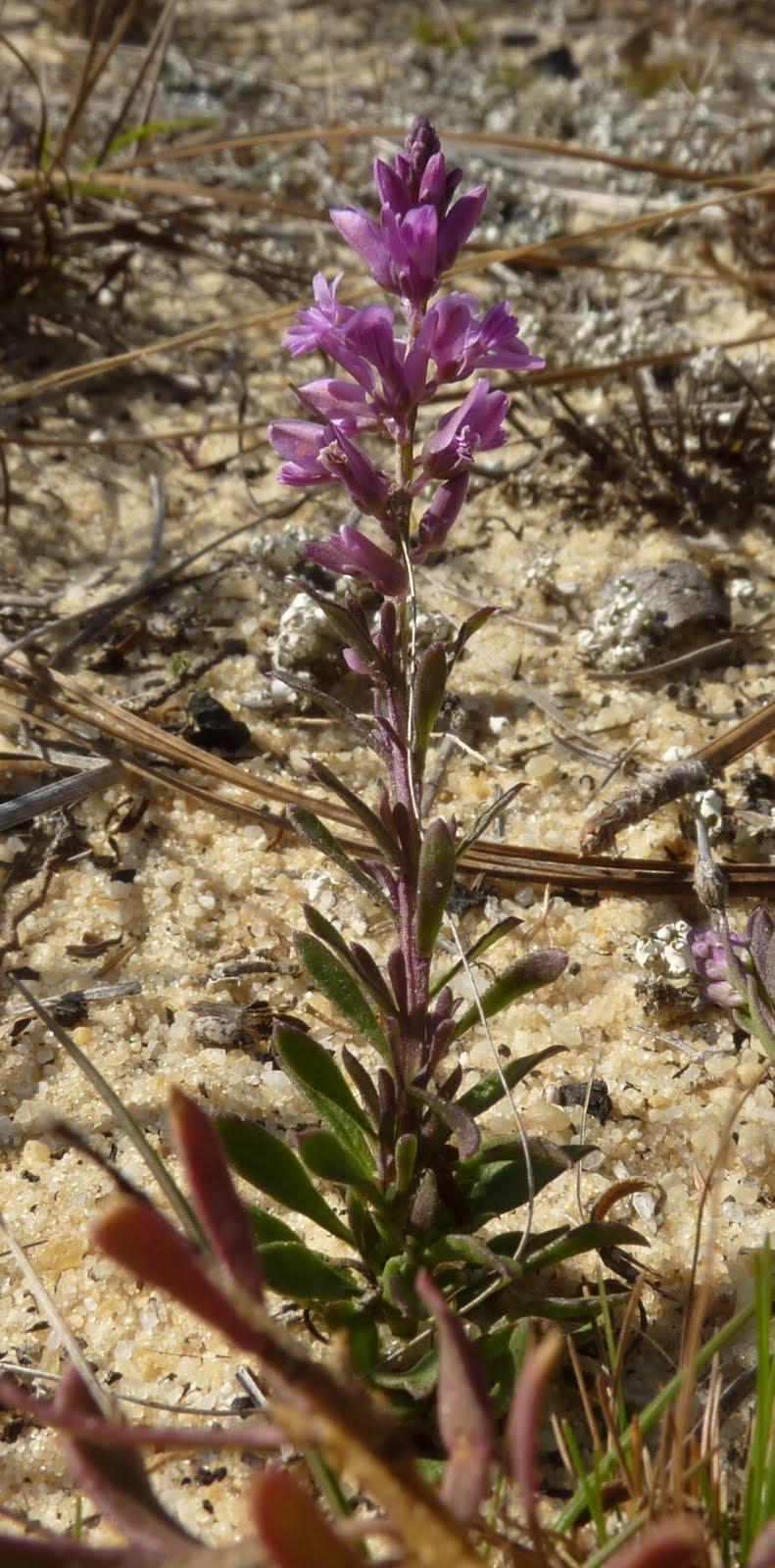
Linda and I drove to Hughes Island yesterday to look for Lewton’s milkwort (Polygala lewtonii). She had a printout of some known GPS locations that we used to locate a few plants to study to establish a “mental search image.” We then spread out and soon began finding more of them, and I’m happy to report that they appear to have a healthy expanding population here. Linda picked this week to look for it because she knew it would be in bloom this month. I was able to get a few decent photographs of this small species, which seldom reaches a height of more than 6 inches.

Wednesday, March 17, 2010

Did I tell you that I like Luckenbach music?

I had just returned home from a 5-day Florida Panhandle work field trip at 7:05pm tonight. I unpacked and started paperwork on field notes and time sheets, but there was a St. Patrick’s Day party going on at the pavilion so it was hard to concentrate. Amplifiers for the country/ western band were set up about a hundred yards from my place, thankfully dialed only to “6” rather than “10.” I tried faithfully to finish my work, really, I did, but then that diabolical band started playing Luckenbach, Texas. One of the band members tried to sound like Waylon Jennings and another like Willie Nelson, and that was the end of me. I love that song. I burst out singing, walked away from the computer and stepped outside, sat down at a picnic table and drank beer and munched on almond clusters. Imagine a band just showing up and playing in your back yard all evening long! Wow! It’s good to be home.

Saturday, March 13, 2010

Two big horns and one small man

I am in west Florida surveying for gopher tortoises for the next several days. I drove to a tract and discovered it is a pasture containing a small herd of longhorn cattle. I have heard that longhorns are fairly docile as far as modern aurochs go, but their horns are 4 ft or more from sharp tip to razor tip, so I was not happy about having to survey the field on foot. When cattle, and especially bulls are around I really, really want my truck as a handy escape module. Some phone calling produced the key to the gate, and after working amongst them for a while, I discovered that the longhorns were really quite docile. So far, anyway.

After working until almost dark, I had noticed a couple of cows braying somewhat insistently, but paid them no mind. When driving up the hill to the gate, I realized the two were bulls, not cows, and one of them was in MY pasture at the fence about 50ft from MY gate. The other bull was on the other side of the road in another pasture. The two bulls were challenging each other, and not just by mooing loudly but also by snorting, pawing the ground, pushing against their respective fences and looking quite wild-eyed. Fifty feet away is not a lot of feet away from a mad bull.

I thought better than to drive straight up to the gate because I figured my bull might take it as a direct challenge and either charge the truck or just come over and skeer me into staying in the truck all night. So I drove wide around the pasture and snuck up to the gate from the far side and stopped. So far, so good. I then slowly, quietly opened the truck door and just as I stepped out to open the gate my bull turned 135 degrees and stared straight at me with fire in his eyes. Gulp. I got back in the truck and waited. Fortunately, the bull did a bit of mental weighing... Buford... the other bull... Buford... the other bull... Aaaah, screw Buford... Then he turned back toward the other bull and continued his testosterone testiness.


Taking another chance, I slowly got out on the OTHER side of the truck and snuck over to open the gate just wide enough to get the truck through it. Meanwhile, two longhorn femmes with horns THIS WIDE stood a bare dozen feet from me, gently chewing their cuds as though to ask, "What's the matter? The bulls won't bother us girls." Stinking cows. Anyway, I made my escape and I hope they break their legs in a gopher hole.

Wednesday, March 10, 2010

The BESG Bird Blog

For once on this blog, I post not about me or mine but about my all-time favorite blog, a birding blog maintained by the Bird Ecology Study Group of the Nature Society in Singapore. Its guiding light in writ was provided by Nobel Laureate Richard P. Feynman, a physicist and a naturalist who must have truly loved birds:

“You can know the name of a bird in all the languages of the world, but when you’re finished, you’ll know absolutely nothing whatever about the bird… So let’s look at the bird and see what it’s doing - that’s what counts. I learned very early the difference between knowing the name of something and knowing something.”

The blog is called simply the BESGroup Website, and is found at
http://besgroup.talfrynature.com/

Every day it contains posts contributed by various members of the group. The photographs are outstanding, nonpareil action shots of avians engaged in the business of life rather than shots like mine of wildlife standing still for a slow shutter. Accompanying texts are short and to the point, explaining what the birds are doing, sometimes adding to the corpus of knowledge about the species’. When I started my own blog, it was with the intention of telling the natural history stories of what I saw and occasionally succeeded in photographing. You might then imagine my delight when I found the BESG blog, as they are head-and-shoulders above my own. I urge you all to visit them every day that you can. Their blog is a masterpiece!

Monday, March 8, 2010

2010 Florida Cave Cavort

The annual Florida Cave Cavort was held this year near Webster FL, hosted by the Tampa Bay Area Grotto of the National Speleological Society. It ran from Friday through Sunday, March 5 – 7, and around a hundred people registered (the usual number). I attended on Saturday and Sunday, and was able to explore Jackpot and Blowing Hole Caves, both of which I had never been to before. Both are controlled by substantial gates made of angle iron steel, and are designed to keep vandals out yet encourage bats and other animals to enter and leave at will.

Vandals are a serious threat to cave resources, spraying enamel paint on walls and calcite formations alike, and the gates and locks keep 99% of them out. There are always a few vandals with special equipment that apparently delight in thwarting conservationists, so if you ever see someone trying to damage a cave gate, please make them aware that you intend to thwart them, and then promptly inform local authorities after obtaining license plate numbers, etc. Vandals also often kill the bats within, destroying common species and imperiled species alike.

Jackpot Cave has a tight entrance that leads to more tight passage, often forcing the caver to remove his helmet to pass restrictions. The portions of the cave that I saw on Saturday can be likened to a pit filled with boulders and cobbles, which the caver must slither amongst to get to the main part of the cave. My small group never did get to the latter, however, as there was a larger, slower group ahead of us that occupied the way onward. We therefore exited the cave without seeing it all. This cave was too gnarly to take my camera into.

Afterward we drove over to Holy Oak Cave, which is not gated and is considered a “sacrificial” cave, and is open to all. Surprisingly, there was less spray paint than in many gated caves I have visited, although names and initials carved into the rock are abundant. There were also three 4-inch diameter corings into the rock, possibly obtained by someone looking for rock samples to analyze? Holy Oak is a single, almost vertical passage perhaps 30 – 40 ft deep that does not require a rope or cable ladder to explore, really all you need is a flashlight. Rainwater has washed black, organic mud down into the cave over part of the rock wall, creating dozens of tiny dams on the rock that are encrusted with a white material, possibly calcite. The overall effect is that of lower lips sporting white, frosted lipstick. This photo gives you an idea of what they look like, and I’ll admit they are nowhere as spectacular as the white or colored calcite formations you surely have seen in National Geographic. The white object in the center of the photo is a mushroom or other type of fungal growth that evidently has hyphae growing within the mud. On the short hike to this cave, we spotted a rather large barred owl (Strix varia) in a longleaf pine, which watched us intently as we stared at it.


We spent a chilly night in the cow pasture cum campground. My tent was covered with frost when I arose in the morning, and Mike and Kitty’s truck camper was covered with breath-frost inside above their heads. Ordinarily at Cavorts, I hear the clanging of pots and pans about a half-hour after first light, but Sunday morning was silent until maybe after an additional half-hour or more. Brrr! I scrambled around, bouncing between fixing/eating breakfast and organizing a trip to Blowing Hole, and we finally drove off at 1030am. Our group included cavers from Jacksonville, Gainesville, Dunellon, Brooksville and somewhere south of Tampa Bay (I forget where Tom lives), a truly interFlorida group.

Blowing Cave is a maternity cave for little brown bats, Myotis austroriparius, although at this time of year there are but few bats present including LBBs and the tricolored bat, Perimyotis subflaveus. The entrance must be negotiated by rope or cable ladder, has a nasty, tight entrance section where you wish your long bones were a little shorter, but once past that spot it bells out and you have plenty of room to climb within. A few feet below the entrance, a nest formed of palm “socks” was nestled in a wall niche. I think it was that of an Eastern phoebe (Sayornis phoebe), but am not really sure.

From the entrance room, a short hands-and-knees passage takes you into the main passages, which are a spacious 8ft high by 8ft wide. There are a fair number of side passages, some similarly-sized and other smaller and less knee-friendly, but nothing really grim. Like Jackpot, there is no mud to slog through and no water to wade through – nice! Plus, there are numerous small calcite formations, nothing of magazine quality but admirable nonetheless.

I’ll end this post with a few pics of the formations and my friends, but not before pointing out that it was a real pleasure to go caving with this group of highly competent, nimble cavers and certainly not before thanking Robert, Tom and Lance for leading this trip.


Friday, February 26, 2010

I am a Torreya Guardian

I first heard about the world’s most endangered coniferous tree, the Florida torreya (Torreya taxifolia) while taking a tree identification course in college in the late 1960s. This species had been reduced in the wild to a few Apalachicola River tributary ravine habitats, which Torreya State Park had been created to include. It was hoped that the species could make a last stand there and, hopefully under state protection, become re-established as a viable population. I have visited that park a few times but have seen no evidence that the Florida torreya is rebounding therein. The last time I walked some of the wilder ravines in the park, all the specimens encountered were small and severely grazed by deer or used by bucks to scrape the velvet off their antlers. None of these plants were receiving any protection whatsoever from deer or other wildlife, and I got the distinct impression that they were doomed by browsers and official inattention.

But this was not always the case. Early botanists described the tree as a prominent mid- and under-story species growing along a 65-km stretch of the Apalachicola River and up its tributaries, achieving up to a meter in circumference and 20 meters in height. A still-unexplained “catastrophe” in the 1950s, however, laid waste to the plants, so now there are only stump and root sprouts within its historic range. It is reminiscent of the chestnut blight, and a similar fungal pathogen is thought to be the culprit although little research into the cause has been done.

Over the years, I have discussed this situation with some of my naturalist friends. All who have seen the torreyas on the state park agree that it is a sad situation and are resigned to losing the species in the long run. I often asked why could we not artificially propagate it and plant it more abundantly within and outside of the state park. Most responses were glass-half-empty statements that need not be repeated, but some of my comrades had the curious, quasi-religious belief that if it didn’t already grow elsewhere then it shouldn’t be planted elsewhere! One fellow actually stated, “If it was meant to be there, it would already be there.” I was astounded at this attitude, but this mentality evidently holds sway over the state park system in regards to the Florida torreya. For shame!

It has been proposed that the Florida torreya might have become “trapped” in a Florida peak-glacial pocket and is unable to naturally re-expand northward into cooler climes, which it possibly prefers as a consequence of the absence of a co-evolved seed disperser. I am not inclined to believe in the seed-disperser hypothesis, though, as squirrels assiduously seek out torreya seeds and eat and presumably cache them, and because the species was propagating itself quite nicely before the 1950s. Fortunately, it has been artificially propagated successfully at the Biltmore Estate in North Carolina and at the Atlanta Botanical Garden. I have seen the Biltmore trees; they are truly beautiful, dark glossy evergreens and I have wanted one ever since.

About a year ago, I read of the Torreya Guardians (http://www.torreyaguardians.org/). This group of dedicated individuals has determined that the species will probably go extinct under current public management policies. Deeming this unacceptable, they have assembled unofficially (no membership roll, no dues and no officers) in the private sector to try to bring the species back from the brink of extinction. They have done quite a lot of research on its propagation requirements, both from cuttings and seeds obtained from Biltmore and Atlanta, and hope to re-establish it within its theoretical cooler-climate range outside of Florida.

As I own a 2-acre lot in the mountains a few miles from Biltmore and (ahem) have a green thumb and a jones for biodiversity, I contacted them asking if they could spare me a few seeds. After many months, they responded with an offer of 10 seeds! But they want me to propagate them in Florida rather than North Carolina because they want to learn whether the species can live in Florida in places other than Torreya State Park. Wow! I am just so excited that I can hardly stand it! I received the seeds today and promptly set them out according to their recommendations. I am now a Torreya Guardian.

Waccasassa Winter

I went kayaking with Jim and Brack yesterday on the Waccasassa River in Levy County, FL. Brack and I became acquainted with Jim by virtue of him being a reader of my blog. As mentioned in the sidebar, one goal of this blog is to meet fellow naturalists from around the country (world), and it was a real pleasure to spend some time in a fine Florida floodplain with another naturalist from a different part of the country - New York, in his case. So, to the rest of y’all: Come on down!

We put in at the boat ramp at the end of CR326 and paddled upstream. It was right cold, too, maybe in the 40s with a perky little breeze, but we were dressed for it with long johns and neoprene socks. Brack’s kayaks are stable and drain splash water quickly, so the only parts of me that got wet were my ankles, and they were only moistened. We left the boat ramp about 10:30am and returned at about 3:30pm, an easy 5-hour loaf.

Passing by the mouth of the Wekiva River, we noted its dark, tannin-stained waters. Ordinarily, this spring-fed tributary’s waters are clear to the bottom and its thick submerged vegetation is clearly visible. Winter rains have swollen the basin’s wetlands and streams, however, carrying heavy loads of leaves and other detritus that contribute dark-colored compounds and particles into the waters. At one point, I tried to shove off a “sandbar” covered with leaves by pushing against it with the paddle, but it just sunk in about 18 inches, proving that the bar was really just a manatee-sized leaf pack. Despite the high waters in the tribs, the river’s level was down due to it being at low tide and close to the sea. Although the current was swift in its shallower reaches, our kayaks slipped easily over the river’s flexed muscles.

Tidal riverbanks and salt marshes are muddy. You almost cannot get in and out of your kayak or canoe without getting muddy feet. Nonetheless, the banks in tidal waters seem to avoid eroding away despite numerous fiddler crab holes and swift currents. Now how can this be? This photo gives you some idea of how algae can provide armor against erosion. The depicted algal mat (the laurel oak leaves in the photo are 2-3 inches long) is filamentous and grows on top of the mud. It is apparent why it can retard erosion, but most mud banks are not so well-protected. Instead, the upper eighth-inch or so of the mud is perfused with thinner, less-visible filaments of algae that enmesh it all together. Jim likened it to a web of fungal hyphae, and upon reflection, I wonder if fungi are also associated with this wetland substrate?

For me, one of the nicest things about Florida is that you can find flowers during any month of the year. Only a few species of wildflowers were blooming yesterday, being common blue violet (Viola sororia), butterweed (Packera glabella) and golden club (Orontium aquaticum), and only one kind of shrub, Walter’s viburnum (V. obovatum). Red buckeye, wax myrtle and swamp privet (the native Forestiera acuminata, not an invasive exotic Ligustrum) exhibited flower buds, but they were not quite yet open for business. Wind-pollinated, leafless trees on the other hand, were starting to bloom pretty good, including sweetgum, winged elm, red maple, bald cypress and coastal plain willow, and possibly others too tall to clearly tell. Fortunately, the oaks and pines were not yet trying to ignite hay fever inflammations.

Where the river passes under CR326, two of the pilings holding the bridge up were badly eroded by physical damage and corrosion. Here is a photo of the worst one, with its reinforcing wires fully exposed! One wonders how many pilings are actually necessary to support this bridge, but I suppose FDOT has made the county build in sufficient redundancy.

Not surprisingly for those who know me, we just had to stop by the solution valley located up one of the Waccasassa’s tributaries that I have mentioned here before. As you may know, a solution valley starts out as a limestone cave whose stream floor has become an above-ground creek because the roof of the cave has eroded away. In this case, remnant side passages still exist, so the big picture is that of a system of little caves pointing toward a small brook. Below are several pics of the system. In one shot of a cavern entrance, you can see the reflection of water lit from behind. In another shot, Brack demonstrates how small these cave entrances are. Most of these holes are too tiny for designation as caves by the Florida Cave Survey, and in several instances are more properly considered natural bridges. All are quite wet and muddy, and there are a lot of natural bridges, too. Also pictured below is cretan brake fern, Pteris cretica. It has the odd distribution of being known in the US only from Florida, Maryland, Louisiana and California.